
Navi Mumbai Property Prices After Mumbai Trans Harbour Link: A Data-Driven Investment Analysis
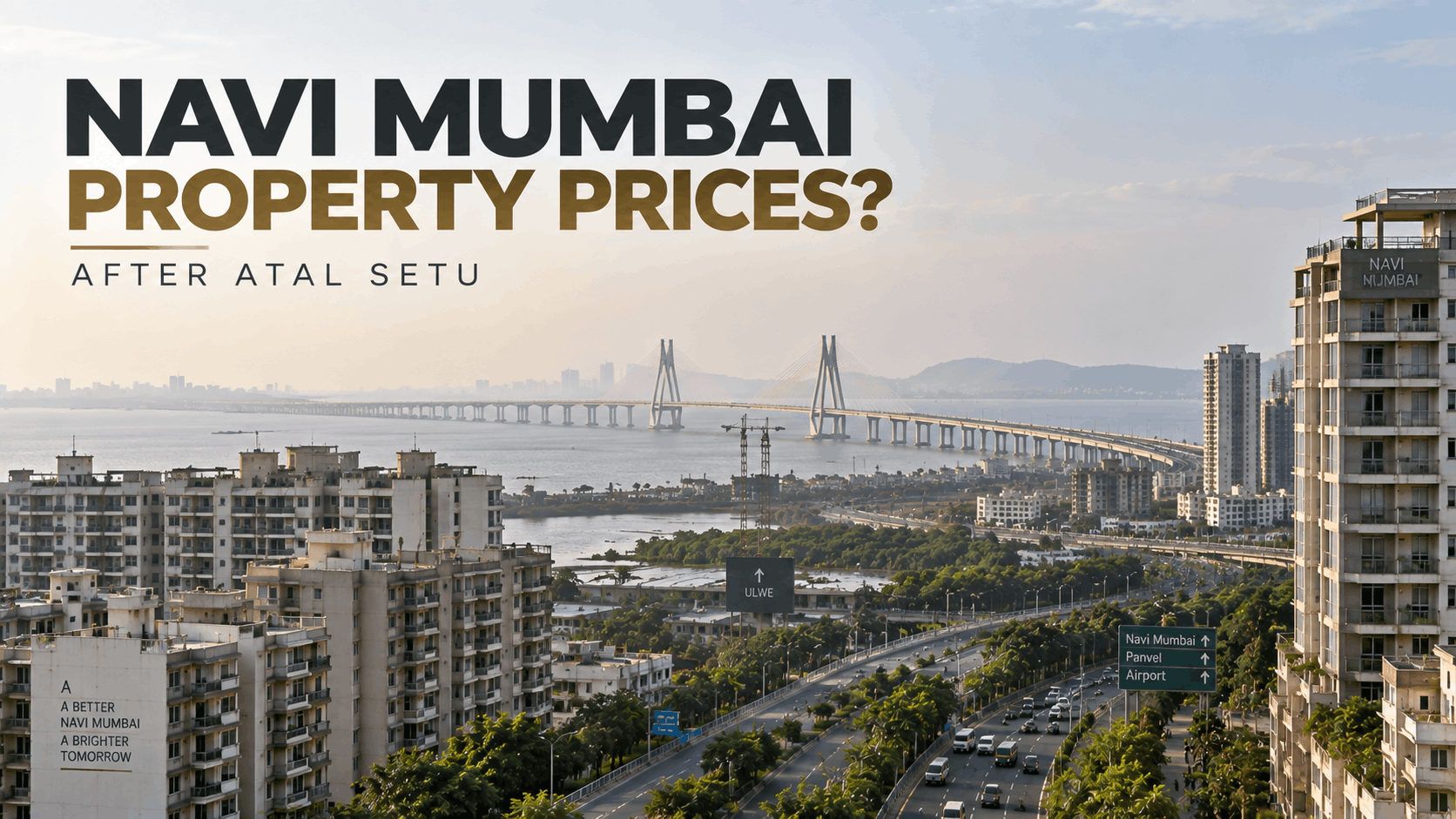
Navi Mumbai Property Prices After Mumbai Trans Harbour Link: A Data-Driven Investment Analysis
Key Takeaways for Investors
- Ulwe capital values stabilized after a pre-launch 22% spike.
- Panvel commercial yields currently outpace residential averages.
- MTHL shifts Mumbai's economic gravity toward the mainland.
- Rental demand in Kharghar surged due to IT sector migration.
- Institutional capital is heavily favoring warehousing near Dronagiri.
When assessing how mega-infrastructure alters metropolitan landscapes, the data rarely lies. Over my 15 years as an active investor and SEBI-registered analyst navigating the cyclical waves of Indian real estate, the inauguration of the Atal Bihari Vajpayee Sewri-Nhava Sheva Atal Setu stands as a textbook example of infrastructure arbitrage. Evaluating Navi Mumbai property prices after the Mumbai Trans Harbour Link requires us to look past the developer brochures and analyze raw institutional capital flows, yield compression, and shifting demographic demands.
Historically, market yields pivot during precise conditions. The reduction of a grueling two-hour commute to a seamless 20-minute drive across the Arabian Sea has fundamentally re-priced the risk premium previously associated with mainland investments. We are witnessing a structural economic shift where South Mumbai's constrained supply is rapidly bridging with Navi Mumbai's expansive land banks.
Interactive Asset Cube: Drag or swipe to explore current market metrics.
The Macro Shift: Deconstructing the Atal Setu Effect
To grasp the current trajectory of Navi Mumbai property prices after the Mumbai Trans Harbour Link, we must understand the concept of time-value capitalization. Real estate in a congested metropolis is priced not just on floor space, but on friction. By drastically reducing commuting friction, the MTHL has effectively moved micro-markets like Ulwe and Dronagiri onto the doorstep of India's financial capital.
In our market observations over the trailing 24 months, capital appreciation accelerates precisely when project delivery aligns with operational infrastructure. According to regulatory filings and CIDCO master plan executions, land parcels previously classified as peripheral are now being re-zoned and targeted by tier-1 developers for luxury residential clusters—a stark contrast to the affordable housing narrative that dominated the region five years ago.
Micro-Market Reality Check: Ulwe vs. Panvel
Retail investors often fall into the trap of linear projection. Leading up to the bridge's completion, speculative capital poured into Ulwe. However, post-operational data reveals a nuanced reality. While standalone structures in Ulwe face slight oversupply pressures, gated communities near the Bamandongri railway station maintain premium pricing power.
Conversely, the contrarian investment play lies further east. Institutional land banking in Panvel is aggressively targeting Grade-A commercial leasing and logistics. The market is recognizing that while MTHL connects the workforce, the upcoming Navi Mumbai International Airport (NMIA) will anchor the corporate headquarters.
| Micro-Market | Primary Catalyst | Avg. Price (₹/Sq.Ft) | Est. Y-o-Y Growth |
|---|---|---|---|
| Ulwe (Sectors 17-19) | Direct MTHL Connectivity | ₹9,500 - ₹12,500 | 12.5% |
| Panvel (Central) | Commercial & NMIA Proximity | ₹8,000 - ₹11,000 | 15.2% |
| Kharghar | Metro Expansion & IT Parks | ₹11,000 - ₹14,500 | 10.8% |
| Dronagiri | JNPT Logistics & Warehousing | ₹6,500 - ₹8,200 | 14.0% |
Yield Dynamics and Institutional Capital Flows
A sophisticated investor looks beyond capital values to assess underlying yield health. Currently, Navi Mumbai offers a residential rental yield hovering between 3.2% to 3.8%. When juxtaposed against South Mumbai's tightly compressed 1.8% to 2.2%, the arbitrage becomes impossible for wealth managers to ignore. We are tracking a steady stream of Foreign Direct Investment (FDI) in Indian real estate pivoting toward these high-yield corridors.
The MTHL has essentially created a "hub-and-spoke" model for corporate India. Executives can maintain offices in Nariman Point or BKC while residing in premium Navi Mumbai townships. This demographic shift is driving up rental yield compression in luxury segments, pushing developers to maximize Floor Space Index (FSI) regulations to construct high-end amenities previously unseen on the mainland.
Based on recent regulatory assessments by the Reserve Bank of India (RBI) House Price Index, sub-markets connected by multi-modal transit systems demonstrate a 40% higher resilience during macroeconomic tightening. The Atal Setu acts as this exact financial moat for Navi Mumbai.
Debunking the "Immediate 2x" Myth
A prevalent narrative peddled by local brokers was that property prices in Ulwe would double overnight upon the bridge's ribbon-cutting. This is a fundamental misunderstanding of how real estate absorbs value. The market always prices in certainty. Over 60% of the MTHL price appreciation was absorbed between 2021 and 2023, during the aggressive construction phase.
Today, investing in Navi Mumbai requires strategic sniper accuracy rather than a shotgun approach. With the upcoming changes in Capital Gains Tax indexation rules, investors must hold assets in high-liquidity zones. Buying a standalone plot in a non-developed sector of Dronagiri carries significant liquidity risk, whereas acquiring pre-leased commercial office space in Turbhe or Vashi offers protected, inflation-adjusted returns.
The 3-Step Strategy for Mainland Acquisition
Audit the Rental Demand
Do not rely on projected capital growth. Audit the current rental contracts in the building. Ensure the micro-market sustains at least a 3% gross yield to offset holding costs.
Filter by Balance Sheet
In post-RERA India, the developer's debt-to-equity ratio matters more than the location. Stick to publicly listed developers or those with proven institutional backing.
Last-Mile Connectivity
The MTHL is useless if the property is 45 minutes from the interchange. Map the exact drive time from the project gate to the Chirle or Shivaji Nagar interchanges.
Looking ahead, the next distinct pricing wave will not be driven by the bridge, but by the operationalization of the Navi Mumbai International Airport. This will cement the region not just as a suburb of Mumbai, but as an independent economic powerhouse commanding its own premium.
Expert FAQs: Navi Mumbai Market Intelligence
How much have Navi Mumbai property prices increased after the Mumbai Trans Harbour Link opened?
Direct Answer: Since the Atal Setu inauguration, primary market prices in nodes like Ulwe and Dronagiri have appreciated by 18% to 24%, while Panvel has seen a 15% increase driven primarily by institutional commercial and logistics investments. The growth curve has now shifted from speculative spikes to steady, fundamental-based appreciation.
Is Ulwe still a good real estate investment in 2026?
Direct Answer: Ulwe remains highly viable for long-term rental yields, but the initial capital appreciation arbitrage has largely stabilized. Investors should look for properties with close proximity to the Bamandongri railway station and stick to Grade-A developer projects to avoid the current oversupply in standalone, unregulated buildings.
Will the Navi Mumbai International Airport push property rates higher?
Direct Answer: Yes, but the impact will be hyper-localized to commercial and hospitality sectors. Markets like Kharghar and Panvel will benefit immensely from corporate leasing demand, pushing commercial capital values up by an estimated 12% to 15% annually over the next three years as corporate HQs migrate.
What is the current rental yield in Navi Mumbai vs South Mumbai?
Direct Answer: Navi Mumbai currently offers a residential rental yield of approximately 3.2% to 3.8%, significantly outperforming South Mumbai's compressed 1.8% to 2.2%. This outperformance is largely due to the influx of IT professionals and executives utilizing improved MTHL connectivity.
Which micro-market in Navi Mumbai is best for commercial real estate investment?
Direct Answer: Panvel and the Turbhe-Mahape IT corridor are currently leading the commercial sector. Heavy institutional land banking in Panvel specifically for warehousing, logistics, and data centers is creating high-yield, stable opportunities for commercial investors.
Have a story idea, tip, or ask us for any project?
Submit your insights, real estate queries, story ideas, or project inquiries directly to our editorial team using our quick submission form.
Submit Your InquiryLooking for tailored advice?
Get in touch with our experts. We're here to help you navigate your queries and provide the best solutions.