
RRTS Impact on NCR Real Estate: The 2026 Master Investment Guide
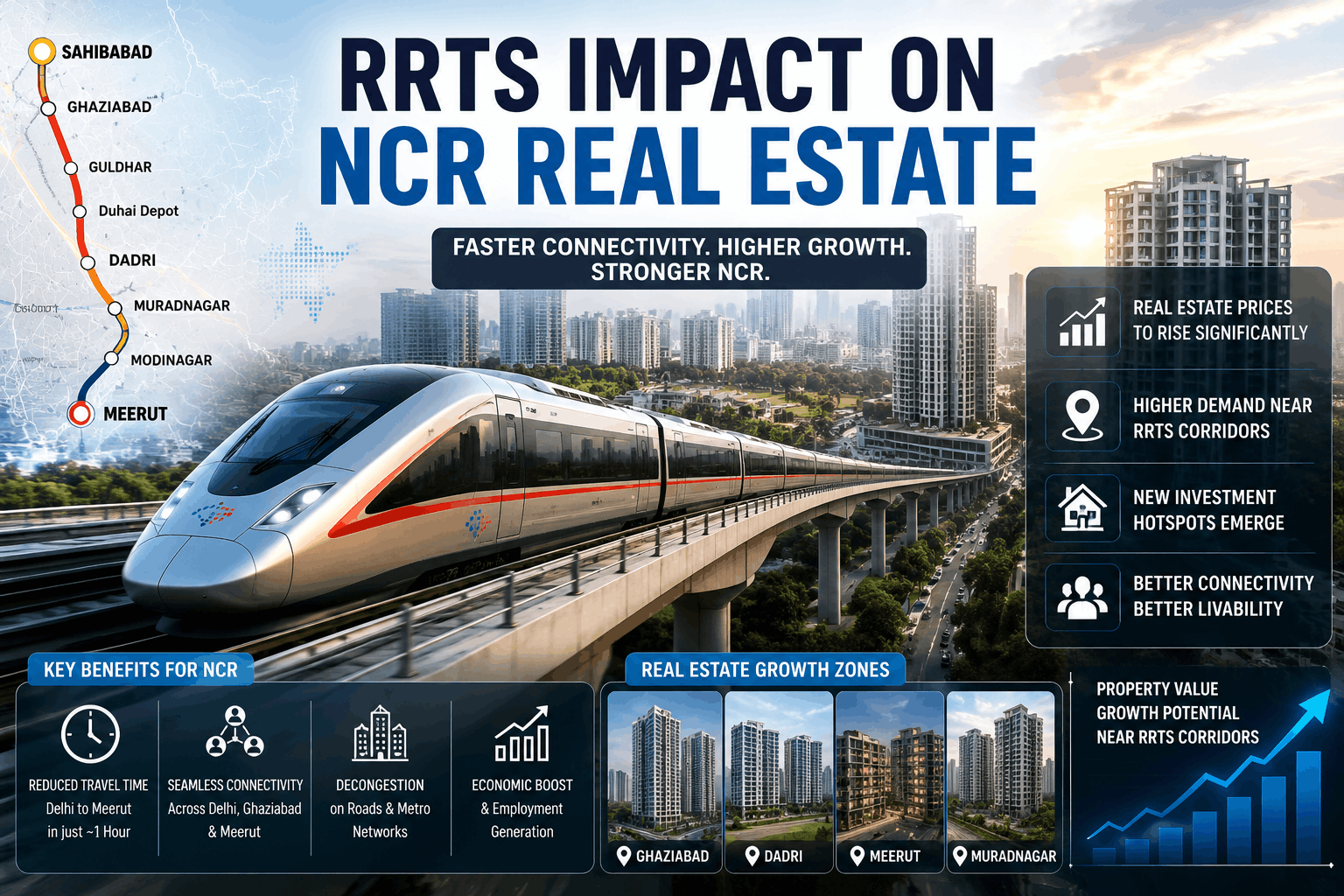
Key Takeaways
- Namo Bharat cuts Delhi-Meerut transit to under 60 minutes.
- Ghaziabad land values spiked up to 67% post-operations.
- Siddharth Vihar shifted from budget housing to luxury investments.
- Transit-Oriented Development zones guarantee long-term asset appreciation.
In our market observations over the last 15 years, genuine infrastructure resets are rare. We see cyclical hype around minor road expansions annually. However, the fully operational Namo Bharat corridor represents a foundational shift in regional mobility. It is actively redefining the geographic boundaries of what constitutes the National Capital Region.
Capital acts like electricity; it takes the path of least resistance. With the National Capital Region Transport Corporation (NCRTC) successfully commissioning the 82-kilometre route, institutional and retail capital is rapidly flowing away from the saturated, hyper-expensive core of Delhi, pouring directly into the adjacent transit nodes of Uttar Pradesh.
The Structural Shift in Property Prices
Let us look at the hard metrics. Five years ago, pockets like Siddharth Vihar were considered quiet, budget-friendly Awas Vikas outposts. Today, they are among the fastest-appreciating residential addresses in India.
Data verifies that flat rates in these transit-adjacent zones have touched ₹10,700 per square foot. We are witnessing a near-doubling of apartment prices over a five-year horizon. This is not a speculative bubble; it is a fundamental repricing backed by end-user occupancy.
| Micro-Market Location | Primary Catalyst | 5-Year Price Appreciation |
|---|---|---|
| Siddharth Vihar (Ghaziabad) | RRTS Station + NH-24 | Approx. 96% Growth |
| Raj Nagar Extension | Hindon Elevated + RRTS | Approx. 60% Growth |
| Modipuram (Meerut) | Namo Bharat Terminus | Approx. 40% Growth |
Debunking the Affordable Housing Myth
There is a dangerous misconception pushed by generic brokers that the RRTS impact on NCR real estate is exclusively a boon for "affordable housing." Our on-ground data contradicts this entirely. When you stack high-speed rail with new expressways, the buyer demographic alters drastically.
Following the inauguration of the Delhi-Dehradun Expressway alongside the rail launch, Ghaziabad experienced an immediate 30% surge. We are seeing luxury investors and High Net Worth Individuals (HNIs) aggressively acquiring 3BHK and 4BHK units. This is a vital lesson for anyone consulting our real estate investment guide: infrastructure stacking creates luxury markets, not budget markets.
Transit-Oriented Development (TOD) Execution
The core strategy driving the Meerut Development Authority is Transit-Oriented Development. Out of 3,273 hectares earmarked in the 2031 master plan, massive swathes are delineated explicitly for TOD zones.
This allows developers a higher Floor Area Ratio (FAR), meaning taller buildings, denser retail spaces, and higher commercial yields. Investors looking beyond residential assets should position capital here. If you prefer liquid assets, evaluating top mutual funds tied to infrastructure developers is a highly strategic proxy play.
Step-by-Step: Evaluating RRTS Corridor Investments
Navigating the NCR real estate landscape requires strict due diligence. Institutional capital flows dictate that retail investors must treat land acquisition with clinical precision. Here is our proprietary verification workflow.
Verify Master Plan Zoning
Never purchase agricultural land under the assumption it will be converted. Demand the local authority's zonal development plan and ensure the plot falls firmly inside the designated Transit-Oriented Development boundary.
Analyze the Infrastructure Stack
Isolate properties that benefit from dual tailwinds. A sector serviced by the Namo Bharat train and an intersecting national highway commands a massive premium over a sector relying solely on the rail line.
Execute RERA & Title Due Diligence
Demand the last 30 years of title history. Ensure the developer holds a valid RERA registration number and cross-verify the encumbrance certificate to guarantee the land is free of litigation.
Frequently Asked Questions
How much have property prices increased due to the RRTS in Ghaziabad?
Property prices in areas like Siddharth Vihar and Raj Nagar Extension have spiked by 30% to 67% over the last few years, fundamentally driven by RRTS operational connectivity.
What is the exact travel time from Delhi to Meerut on the Namo Bharat train?
The fully operational Namo Bharat corridor cuts the travel time between Sarai Kale Khan in Delhi and Modipuram in Meerut to less than 60 minutes.
Which sectors in Meerut are best for residential plot investment?
Modipuram, Pallavpuram, and Shatabdi Nagar are currently the prime hubs, recording significant capital appreciation due to their direct proximity to the transit stations.
What is Transit-Oriented Development (TOD) in the context of Namo Bharat?
TOD refers to the creation of dense, mixed-use commercial and residential zones within a tight radius of RRTS stations, designed to maximize public transport ridership and reduce car dependency.
Has the RRTS impacted rental yields in Siddharth Vihar?
Yes, rental yields in Siddharth Vihar currently sit at a healthy 3% to 4%, bolstered by IT professionals commuting to Noida Sector 62 and 63.
Are commercial real estate investments viable near RRTS stations?
Absolutely. High footfall transit nodes make retail and service-based commercial properties highly lucrative, though the institutional shift takes longer than residential appreciation.
How does the Delhi-Dehradun Expressway combine with RRTS for price surges?
The stacking of rail (RRTS) and road (Expressway) infrastructure in Ghaziabad creates a dual-accessibility premium, shifting buyer profiles from budget end-users to luxury-seeking High Net Worth Individuals (HNIs).
What are the risks of investing in land near the RRTS corridor?
The primary risks involve land title disputes, ambiguous zoning laws outside established master plans, and phased delivery delays by developers leveraging the infrastructure hype.
How will the upcoming RRTS corridors affect Gurugram properties?
Future corridors connecting Gurugram are already pricing in a 10% to 18% premium in anticipated sectors like New Gurgaon, anchoring localized micro-markets.
Is Modipuram a safe bet for long-term real estate holding?
Yes, Modipuram sits at a crucial transit junction. As institutional capital enters the Meerut peripheral zones, Modipuram acts as a reliable long-term hold.
Will property prices crash after the RRTS is fully saturated?
A crash is highly unlikely. Instead, the market will experience price stabilization and yield compression as the localities mature from speculative zones to end-user dominant markets.
How does the Namo Bharat project compare to the Delhi Metro expansion?
While the Metro handles high-frequency, short-distance urban commuting, the RRTS is designed for high-speed (up to 160 km/h) intercity transit, effectively expanding the borders of the NCR.
Should retail investors prioritize flats or agricultural land near stations?
Retail investors should prioritize RERA-approved flats for safer, immediate rental yields. Agricultural land offers massive upside but carries severe zoning and legal conversion risks.
Are high-net-worth individuals (HNIs) buying in Ghaziabad now?
Yes. Areas like Siddharth Vihar have transitioned from affordable housing to premium 3BHK and 4BHK markets specifically targeted by HNIs capitalizing on the connectivity.
What is the institutional outlook on NCR real estate for 2027?
Institutions expect polycentric growth. Capital will decentralize from core Delhi and Gurugram into strategically connected satellite nodes in UP and Haryana.
How do upcoming RRTS phases impact the Yamuna Expressway region?
The proposed linkages will integrate the Noida International Airport with the wider NCR, structurally multiplying the valuation of commercial assets along the Yamuna Expressway.
Is it too late to invest in Raj Nagar Extension?
While the initial speculative 50% jump has already occurred, steady, compounding end-user demand makes it a solid, low-risk portfolio addition for conservative investors.
How can buyers verify land titles near the RRTS route?
Always demand the chain of title for the last 30 years, verify RERA registration, cross-check the local development authority's master plan, and mandate encumbrance certificates.
Have a story idea, tip, or ask us for any project?
Submit your insights, real estate queries, story ideas, or project inquiries directly to our editorial team using our quick submission form.
Submit Your InquiryLooking for tailored advice?
Get in touch with our experts. We're here to help you navigate your queries and provide the best solutions.