
Noida vs Noida Extension Real Estate: The Ultimate 2026 Investment & Valuation Guide
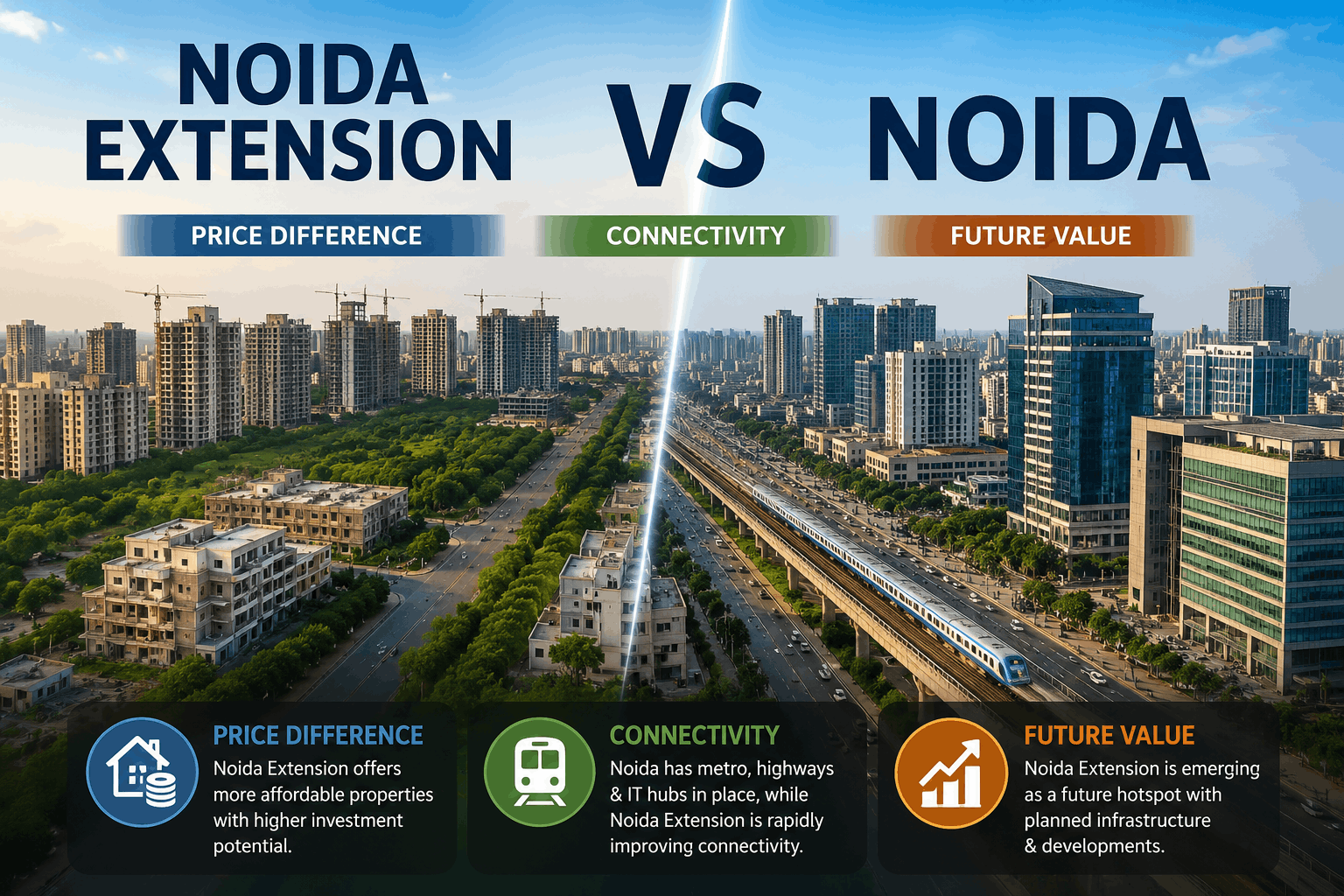
Key Takeaways
- Noida offers legacy premium status, higher yields, and immediate metro access.
- Noida Extension provides middle-market affordability and high future appreciation potential.
- Amitabh Kant Committee guidelines are actively unlocking stalled registries locally.
- FNG Expressway and Aqua Line will trigger massive valuation resets.
- GNIDA’s aggressive FAR policy created Extension’s high-density skyline architecture.
Hello, I’m Ashvani. With over 15 years as a SEBI-registered financial analyst navigating the trenches of the Indian real estate market, I routinely encounter one persistent question from both institutional buyers and first-time retail investors: Where should I deploy capital in 2026—Noida or Noida Extension?
The National Capital Region (NCR) real estate market is notoriously complex. However, understanding the Noida vs Noida Extension real estate dynamic requires looking past glossy developer brochures and analyzing hard macroeconomic data. These two adjacent markets represent vastly different investment philosophies, risk profiles, and regulatory histories.
In this comprehensive master guide, we strip away the marketing noise. We will analyze real-time price metrics, decode the structural policies that shaped these skylines, and forecast exactly how the impending Jewar Airport and Aqua Line expansion will redirect capital flows. If you are preparing to read our broader NCR real estate investment guide, consider this the mandatory prerequisite.
The Genesis: Diverging Administrative Origins
You cannot underwrite an investment in this region without understanding its history. The New Okhla Industrial Development Authority (NOIDA) was incorporated in 1976. It was methodically planned on an employment-first model. The authority first lured manufacturing, followed by IT giants in the late 1990s via SEZs (Special Economic Zones). Housing was built merely to support the corporate workforce, resulting in low-density sectors and wide, well-maintained arterial grids.
Conversely, Noida Extension—formally rebranded as Greater Noida West by the Greater Noida Industrial Development Authority (GNIDA)—was conceptualized around 2008-2009 for an entirely different purpose. Driven by an urgent spillover demand from the middle class who were priced out of central Noida and Delhi, GNIDA acquired agricultural land across villages like Shahberi and Patwari. The functional intent here was inherently residential. Developers were incentivized to build massive group housing societies before any legitimate commercial ecosystem existed.
By The Numbers: Valuations and Capital Appreciation
In our market observations, capital allocation must be driven by data, not emotion. Today, central Noida is facing severe land scarcity. The limited inventory available in premium sectors is largely restricted to the secondary (resale) market or ultra-luxury new launches. Noida Extension holds the lion's share of primary and under-construction inventory.
| Market Metric | Central Noida (Sec 78, 150) | Noida Extension (Gaur City, Tech Zone 4) |
|---|---|---|
| Average Capital Value | ₹10,000 – ₹18,000+ per sq. ft. | ₹6,000 – ₹9,000 per sq. ft. |
| Average Rental Yield | 3.0% – 4.5% | 2.5% – 3.0% |
| Primary Buyer Demographic | HNIs, Corporate Executives, Upgraders | Millennials, First-Time Buyers, IT Professionals |
| Market Phase | Mature / Saturated / Ultra-Luxury Pivot | Growth / Density Absorption / Mid-Segment |
While Noida commands superior capital values, Noida Extension offers an asymmetrical upside for the retail investor. The entry barrier is significantly lower, and the runway for localized infrastructure development (which drives appreciation) is much longer.
The Information Gap: The FAR Policy Advantage
Here is a contrarian market view often missed by mainstream analysts: The visual starkness between Noida's sprawling houses and Noida Extension's towering concrete jungle isn't just about builder greed; it is a direct result of urban policy. The Ministry of Housing and Urban Affairs (MoHUA) and local bodies manipulate Floor Area Ratio (FAR) to control density.
Older Noida sectors were restricted to lower FAR limits (often around 1.5 to 2.75). To make housing affordable for the masses in Noida Extension, GNIDA permitted developers a massively elevated FAR (frequently exceeding 3.5+). This allowed builders to stack 30-story high-rises on relatively small plots. As an investor assessing commercial property yields or residential resale velocity, you must factor in this hyper-density. High density guarantees localized retail footfall but puts immense strain on civic amenities.
Infrastructure Arbitrage: Metro and Expressways
Real estate value in the NCR is inextricably linked to commute times. Historically, Noida held the ultimate advantage with immediate access to the DND Flyway and the Delhi Metro Blue and Magenta lines. Noida Extension was virtually landlocked, relying on congested village roads.
This dynamic is violently shifting. The Faridabad-Noida-Ghaziabad (FNG) Expressway is actively filling in the missing links. More importantly, the central government has greenlit the Aqua Line Metro extension branching from Sector 51 into Greater Noida West. Once this line is physically operational, the "connectivity discount" applied to Noida Extension will vanish, triggering a severe upward price correction.
Surviving The Registry Crisis: UP RERA and Amitabh Kant
No discussion on Noida vs Noida Extension real estate is complete without addressing the elephant in the room: stalled registries. Thousands of homeowners have possession of their flats but lack legal title because developers owe massive land dues to GNIDA and NOIDA authorities.
Fortunately, state intervention is actively de-risking the market. Based on the Amitabh Kant Committee's recommendations, the government has instituted a rehabilitation package. If you are currently navigating this, you must review our UP RERA compliance checklist.
The Zero Period Waiver
The state government waives off punitive penal interest on developer land dues accumulated during COVID-19 and active NGT construction bans.
Fractional Upfront Payment
Developers are mandated to pay 25% of their recalculated, reduced land dues upfront to the respective authority (NOIDA or GNIDA).
Registry Unlocking
Upon receipt of the 25% payment, authorities instantly grant permission to execute sub-leases, allowing individual homebuyers to officially register their apartments.
Future Projections: The Jewar Airport Effect
Looking toward 2030, the operationalization of the Noida International Airport (Jewar) will structurally alter both micro-markets. The airport will anchor a massive logistics and corporate ecosystem along the Yamuna Expressway.
Central Noida will transition fully into the administrative and luxury nerve center, commanding ultra-premium valuations akin to South Delhi. Noida Extension, sitting perfectly in the geographic middle, will become the primary residential hub for the millions of middle-management professionals servicing these new global supply chains.
Frequently Asked Questions
Q1: What is the current average price difference between Noida and Noida Extension?
Currently, premium sectors in Noida command prices between ₹10,000 to ₹18,000+ per sq. ft., while Noida Extension ranges from ₹6,000 to ₹9,000 per sq. ft., depending on the developer and exact location.
Q2: Why is Noida Extension called Greater Noida West?
Noida Extension was officially rebranded as Greater Noida West by GNIDA to integrate it formally into the Greater Noida master plan and distance the micro-market from the land acquisition controversies of 2011.
Q3: Are properties in Noida Extension safe to invest in today?
Yes, provided the project is UP RERA registered and the developer has cleared their land dues with GNIDA. The implementation of the Amitabh Kant Committee recommendations has made the market significantly safer for buyers.
Q4: Which area offers better rental yields for investors?
Central Noida offers slightly higher rental yields (3-4%) due to its immediate proximity to commercial IT hubs and legacy infrastructure. Noida Extension currently yields around 2.5-3% due to higher localized inventory supply.
Q5: What is the status of the Metro in Noida Extension?
The Aqua Line Metro extension branching from Sector 51 into Greater Noida West is approved by the central government. Ground clearing and initial pillar assessments are currently underway, with operations projected in the coming years.
Q6: Why are there so many high-rises in Noida Extension compared to Noida?
GNIDA allotted a much higher Floor Area Ratio (FAR) to developers in Noida Extension to make affordable housing economically viable. This policy allowed builders to construct 25-30 story towers, unlike the low-density plots of older Noida.
Q7: How is the registry issue being resolved in Noida Extension?
The UP Government is executing a rehabilitation package that waives penal interest for the 'zero period' (COVID and NGT bans) if developers pay a 25% upfront fraction of their land dues, which immediately unlocks registry permissions for homeowners.
Q8: Will the Jewar Airport impact Noida Extension property prices?
Yes. As Jewar Airport turns the Yamuna Expressway into a global logistics hub, the resulting job creation will drive immense demand for middle-income housing in Noida Extension, pushing capital values higher.
Q9: What is the FNG Expressway and why does it matter?
The Faridabad-Noida-Ghaziabad (FNG) Expressway is a bypass corridor. Once fully operational, it will drastically cut commute times for Noida Extension residents travelling to Haryana and Ghaziabad, boosting local property valuations.
Q10: Who are the top reliable developers in Noida Extension?
Top-tier developers with consistent delivery records in Greater Noida West include Gaursons (Gaur City), ATS, Mahagun, and CRC. Always verify a developer's RERA compliance before investing.
Q11: Is Noida Extension suitable for luxury living?
While historically an affordable market, Noida Extension is now seeing the launch of 'luxury-lite' projects featuring larger floor plates, premium clubhouses, and lower density to cater to upwardly mobile professionals.
Q12: What are the biggest challenges of living in Noida Extension?
The primary challenges are severe peak-hour traffic bottlenecks at the Gaur City roundabout, the lack of operational metro connectivity, and a shortage of multi-specialty tertiary care hospitals within the immediate micro-market.
Q13: Does central Noida have any new residential projects left?
Very few. Central Noida is largely landlocked with minimal greenfield plots left. New launches are predominantly ultra-luxury, high-ticket projects located in outer sectors like Sector 150.
Q14: Can NRIs invest in Noida Extension?
Absolutely. NRIs can easily invest in UP RERA registered projects in Noida Extension using standard FEMA guidelines and NRO/NRE accounts. The transparent RERA portal has significantly increased NRI investor confidence.
Q15: When is the best time to buy a home in Noida Extension?
The optimal time is now, before the Aqua Line Metro extension and FNG expressway are fully commissioned. Once these infrastructure milestones are physically active, property prices will undergo a rapid 15-20% upward correction.
Have a story idea, tip, or ask us for any project?
Submit your insights, real estate queries, story ideas, or project inquiries directly to our editorial team using our quick submission form.
Submit Your InquiryLooking for tailored advice?
Get in touch with our experts. We're here to help you navigate your queries and provide the best solutions.