
The Ultimate 2026 Noida Real Estate Investment Guide: Expert Market Analysis & Top Sectors
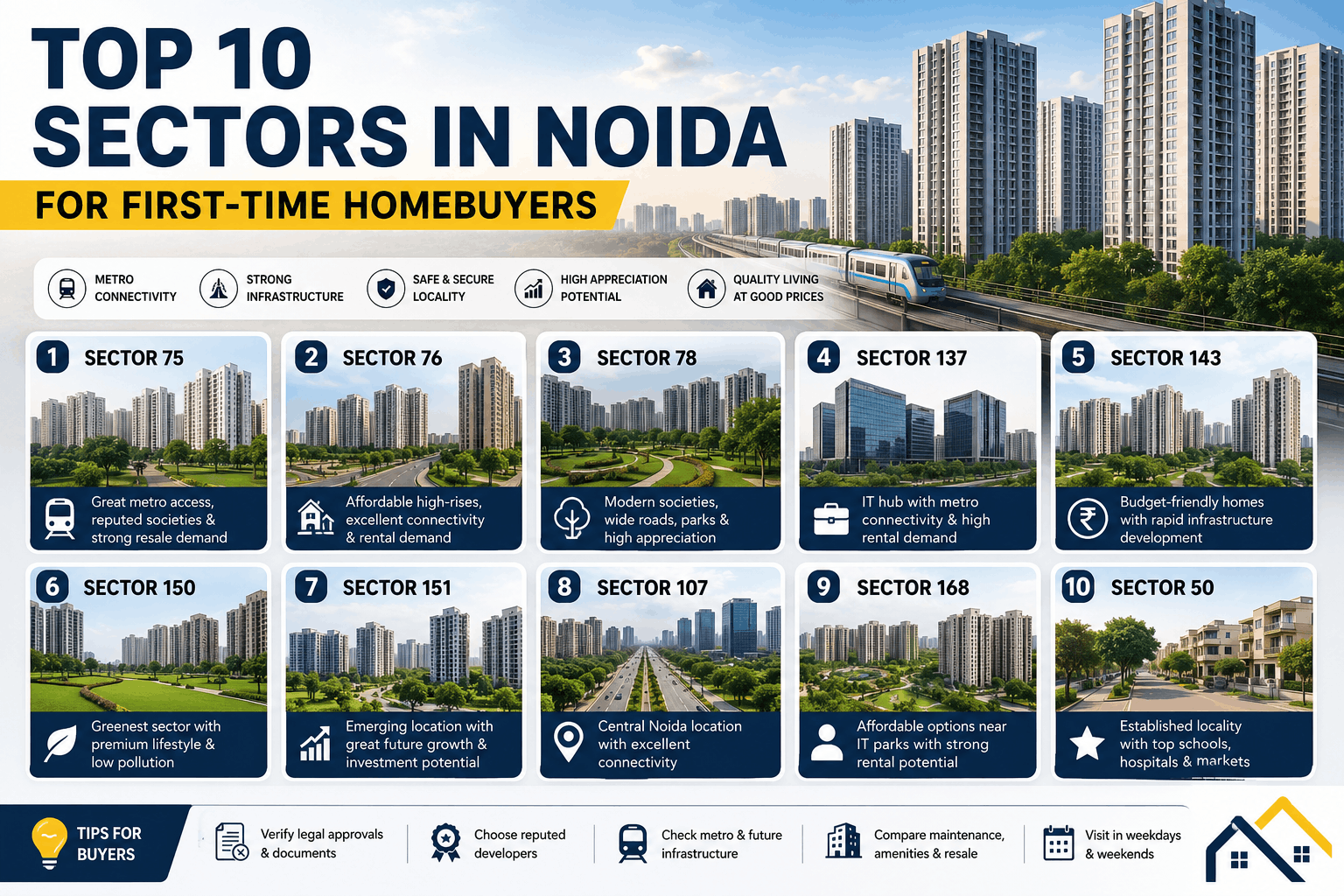
Key Takeaways
- Sector 150 emerges as Noida’s premier green investment hub.
- Central sectors (74-78) offer unmatched immediate social infrastructure.
- Jewar Airport operationalization guarantees massive Expressway price appreciation.
- RERA enforcement mathematically stabilizes delivery timelines for buyers.
- Hybrid work demands push buyers toward spacious peripheral 3BHKs.
In our market observations over the past 15 years, the transformation of Noida from a suburban industrial outpost to a highly coveted global real estate hub is unprecedented. A decade ago, financial media relentlessly criticized this market as the epicenter of builder bankruptcies. Today, institutional capital flows and aggressive infrastructure development have entirely rewritten the narrative.
For a first-time homebuyer or an institutional investor, navigating this market requires looking past superficial marketing brochures. You need hard data on Floor Area Ratios (FAR), UP RERA compliance, and infrastructural catalyst points. This comprehensive guide dissects the historical realities, the present 2026 market dynamics, and the future trajectory of Noida's residential landscape.
The Evolution: From Agricultural Villages to Megacity Grid
Noida is not an organically grown city; it is a meticulously calculated state-planned grid. Created in 1976 under the UP Industrial Area Development Act, the New Okhla Industrial Development Authority acquired agricultural land to decongest Delhi. Sectors directly on the Delhi border (like 15, 19, and 22) were developed first to house public sector employees.
Unlike Gurugram, where private developers built luxury enclaves before the government could lay sewage pipes, Noida Authority maintained primary control. They built wide roads, parks, and drainage grids before auctioning land parcels. This fundamental difference in urban planning is exactly why we continue to recommend Noida as the superior structural long-term play in NCR real estate trends.
The Catalyst of Crisis: RERA and SWAMIH
We cannot discuss Noida without addressing its historical failures. The 2011 farmer protests over land compensation in Greater Noida West halted construction entirely. By the mid-2010s, massive financial mismanagement by legacy developers left millions of square feet unfinished.
However, the implementation of the Real Estate (Regulation and Development) Act (RERA) in 2016 was the ultimate market cleanser. Mandating that 70% of project funds sit in escrow accounts eliminated fund diversion. Combined with the government-backed SWAMIH fund currently reviving stalled legacy projects, buyer confidence has been mathematically restored.
Market Matrix: Top Sectors for Buyers in 2026
Based on current capital deployment, the market is sharply segmented based on buyer demographics, budget, and end-use goals.
| Micro-Market Zone | Key Sectors | Target Demographic | Avg. 2BHK Value (2026) |
|---|---|---|---|
| Central Noida (Mid-Income) | 74, 75, 76, 78 | Young Families, Metro Commuters | ₹75 Lakh – ₹1.2 Cr |
| Noida Expressway (Premium) | 137, 143, 144 | IT Professionals, Tech Executives | ₹1.1 Cr – ₹1.8 Cr |
| Greater Noida West | Sectors 1, 4, 16 | First-time Budget Buyers | ₹55 Lakh – ₹85 Lakh |
| Ultra-Premium Green Belt | 150, 152 | HNIs, NRIs, Luxury Investors | ₹1.8 Cr – ₹3.5 Cr+ |
Sector 78 remains the holy grail for immediate livability. Buyers here pay a premium to bypass the waiting period for social infrastructure. Conversely, the Aqua Line metro has fundamentally altered the valuation of Expressway sectors like 137, transforming them from isolated car-dependent suburbs into integrated tech corridors.
The Future Trajectory: Jewar Airport & Sector 150
Over the next decade, Noida's property values will converge heavily with Gurugram's premium pricing. The "affordable cousin" tag is dead. The operationalization of the Jewar International Airport is the largest infrastructural catalyst in North India, rapidly mutating the Expressway into a global logistics and corporate mega-hub.
Sector 150 is aggressively positioning itself as the "Golf Course Road of Noida." With a master plan dedicating 80% of the land to green spaces, incoming international sports facilities, and strict low-density zoning, this sector commands extreme premiums as clean air becomes the ultimate luxury commodity in the NCR.
Step-by-Step: Executing a Safe Property Transaction
Institutional buying relies heavily on strict due diligence. Retail buyers must adopt the exact same framework. Navigating the property registration process in Noida requires systematic verification to avoid litigation traps.
UP RERA Background Check
Never rely on a builder’s brochure. Input the RERA registration number directly into the official portal to check for active litigations, land title disputes, and exact escrow fund balances.
Noida Authority Dues Verification
A primary bottleneck in Noida is the halting of registries due to the builder owing massive land dues to the Noida Authority. Demand the 'No Dues Certificate' (NDC) before initiating any token payment.
Physical Macro-Infrastructure Audit
Do not just look at the clubhouse. Investigate the capacity of the sector’s electrical sub-station, the width of the approach roads against the proposed density, and the exact distance to the nearest operational Aqua/Blue line metro node.
If physical property management seems overwhelmingly complex in high-density corridors, investors can alternatively allocate capital via real estate mutual funds or REITs focused on commercial IT parks in Sector 62 and Expressway zones.
Deep-Dive Market FAQs
Below are 15 critical questions we receive from institutional and first-time buyers analyzing the 2026 macro-environment.
1. What are the top recommended sectors for first-time homebuyers in Noida in 2026?
The top sectors in 2026 include 75, 76, 78, 137, 62, 120, 49, 150, 74, and Greater Noida West. These micro-markets offer a proven balance of livability, budget flexibility, and steady capital appreciation backed by mature infrastructure.
2. Why is Sector 78 highly preferred by young families?
Sector 78 offers mature social infrastructure, direct Aqua Line metro access, and high-quality gated societies at mid-segment pricing. Buyers choose it to entirely eliminate the usual 5-year wait for neighborhood development common in newly launched sectors.
3. What is the average budget required for a 2BHK flat in Central Noida?
A standard 2BHK in central mid-income sectors like 75 or 76 currently ranges between ₹75 Lakh to ₹1.2 Crore. Pricing is highly dependent on the builder's track record, society maintenance quality, and proximity to the Sector 52 Blue Line interchange.
4. How is the Aqua Line metro benefiting Expressway sectors?
Before the Aqua Line, Expressway residents were strictly car-dependent. The operational metro provides critical high-speed transit to Central Noida and Delhi, dramatically improving commutes for IT professionals and instantly driving up rental yields in sectors like 137 and 143.
5. Who drives the residential demand in Sector 62?
Demand in Sector 62 is entirely dominated by IT professionals, BPO executives, and students attached to massive commercial hubs like I-Thum, Corenthum, and major educational institutions. This guarantees investors a zero-vacancy rental market.
6. Is Greater Noida West still an affordable option?
Yes. Despite the overall price appreciation across the NCR, Greater Noida West (Noida Extension) remains the most viable entry point for budget-conscious buyers, offering modern housing under the ₹60 Lakh mark for an entry-level 2BHK.
7. What challenges do homebuyers face in Noida's current market?
First-time buyers currently grapple with rapidly rising property prices, exorbitant state registry costs, bureaucratic hurdles in societies where builders owe government dues, and ongoing maintenance quality disputes in highly dense older high-rises.
8. How is the hybrid work model altering buyer preferences?
Because daily commuting has decreased, buyers are prioritizing larger internal spaces—specifically 3BHKs or flats with dedicated study rooms. This allows them to invest in peripheral sectors for better square-footage value rather than cramming into central 2BHKs.
9. What demographic invests in Expressway sectors like 150?
Buyers here are typically mid-to-senior IT executives, High Net-Worth Individuals (HNIs), Non-Resident Indians (NRIs), and dual-income couples seeking premium, low-density, sports-centric lifestyles far removed from city congestion.
10. How has the media perception of Noida real estate changed?
The media has executed a sharp pivot. Coverage no longer focuses on historical builder delays. Instead, it portrays Noida as a premium, infrastructure-rich investment hub, heavily emphasizing aggressive capital appreciation driven by Jewar Airport and global data centers.
11. What are the property rates in older sectors like Sector 49?
Rates in older, established pockets like Sector 49 currently hover between ₹5,000 to ₹7,000 per square foot. They lack flashy clubhouses but provide excellent value for buyers prioritizing immediate civic infrastructure and local markets.
12. How will Jewar International Airport impact property prices?
The operationalization of Jewar Airport is projected to cause a massive, sustained surge in valuations along the Expressway. As logistics, hospitality, and multinational corporates establish bases, nearby residential nodes will experience double-digit annual appreciation.
13. Are there long-term risks to investing in Greater Noida West?
Yes. Future macro-risks include severe traffic bottlenecks on approach highways, potential groundwater depletion, and immense strain on public utilities due to the extreme, unprecedented population density planned for the region over the next decade.
14. What new housing models will dominate Noida in the future?
Expect a massive surge in IoT-integrated smart homes tailored for tech workers, mixed-use walk-to-work developments combining malls and offices, and specialized luxury senior-living enclaves designed to support an aging upper-middle-class demographic.
15. How is the SWAMIH fund aiding Noida real estate?
The government-backed SWAMIH investment fund is actively financing the completion of legacy stalled projects (like those of Amrapali and Jaypee). This critical intervention allows state agencies like NBCC to finally hand over keys to thousands of long-waiting buyers.
Have a story idea, tip, or ask us for any project?
Submit your insights, real estate queries, story ideas, or project inquiries directly to our editorial team using our quick submission form.
Submit Your InquiryLooking for tailored advice?
Get in touch with our experts. We're here to help you navigate your queries and provide the best solutions.