
Yamuna Expressway Real Estate & Infrastructure: The Ultimate Investor's Guide (2026)
Key Takeaways
- Jewar Airport launch radically accelerates regional land demand.
- YEIDA 2041 Master Plan prioritizes integrated "Aerotropolis" mega-development.
- Suraksha Group takeover stabilizes Jaypee Infratech operational assets.
- Concrete rigid pavement enables heavy high-speed commercial freight.
- IIT Delhi audits enforce mandatory 75 km/h winter speed limits.
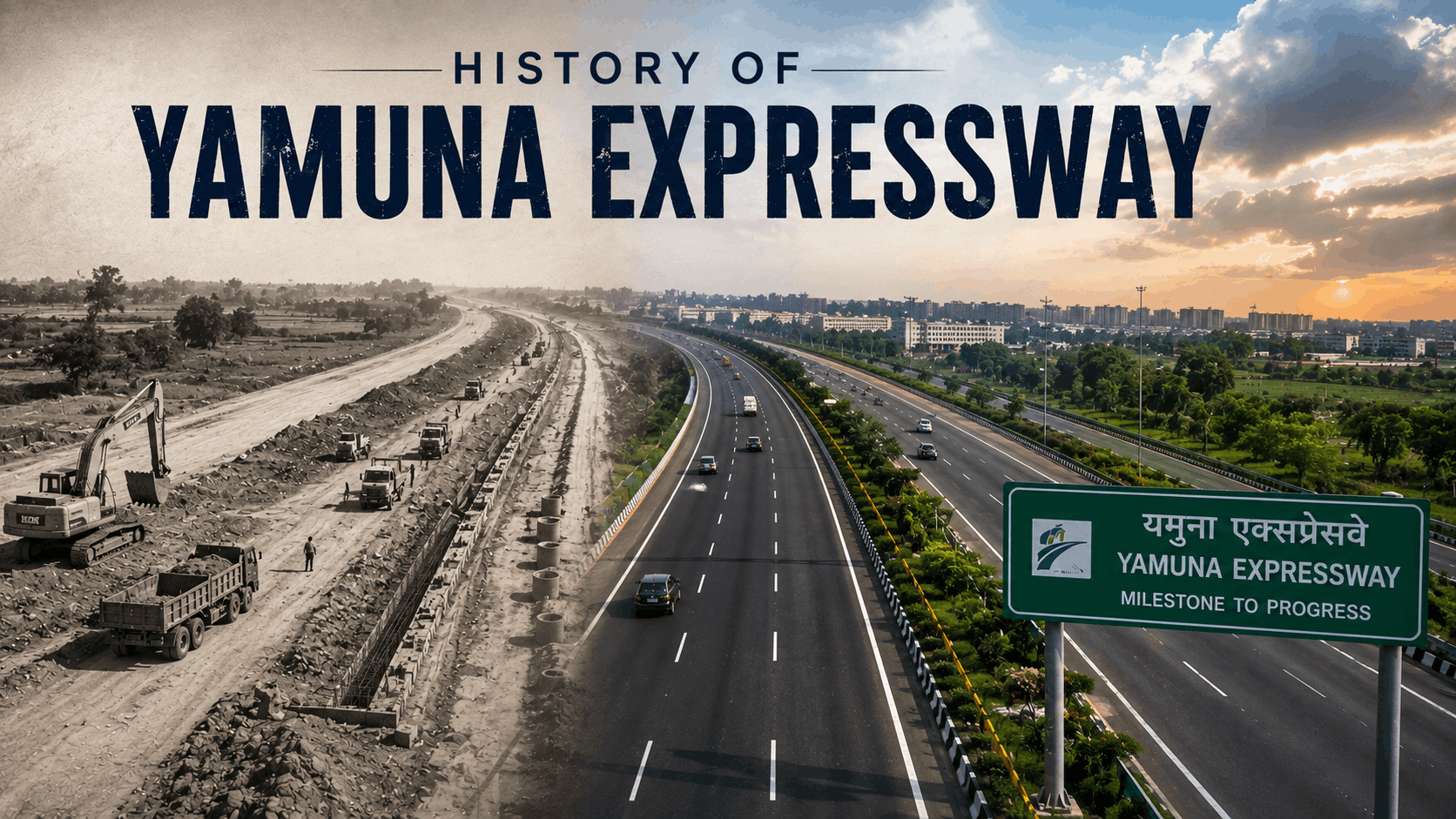
In our market observations over the last 15 years, very few infrastructure corridors have fundamentally rewritten an entire state's economic trajectory quite like the Yamuna Expressway. Stretching 165.5 km from Greater Noida to Agra, this access-controlled marvel is no longer just a high-speed route to the Taj Mahal. It is the geographic spine of India's next massive real estate boom.
Institutional capital flows are heavily favoring this region right now. We are moving past the early speculation phase and entering the hard infrastructure delivery phase. For retail investors and heavy-weight developers alike, understanding the intricate layers of the Yamuna Expressway real estate market is mandatory before deploying capital.
Decoding the YEIDA Master Plan 2041
The Yamuna Expressway Industrial Development Authority (YEIDA) holds the keys to the kingdom here. To prevent unauthorized urban sprawl and replicate the organized success of NCR real estate dynamics, YEIDA’s Master Plan 2041 has clearly delineated the land parcels along the highway into distinct functional zones. This isn't just about plotting residential units; it is about building a self-sustaining city.
By 2041, the authority envisions a sprawling "Aerotropolis"—an urban ecosystem radiating outward from the Noida International Airport at Jewar. This includes Sector 29 through 33 earmarked for high-density residential nodes, while Sectors 18 to 22 focus heavily on non-polluting industrial corridors.
| Development Sector | Primary Zoning Purpose | Projected Target Milestone |
|---|---|---|
| Sector 21 | International Film City Hub | Phase 1 Operations by 2028 |
| Sector 28 | Medical Device Park | Immediate Core Allocation |
| Tappal Bajna (Aligarh) | Multimodal Logistics Park (MMLP) | Aligned with Airport Launch |
| Sector 29, 32, 33 | Integrated Residential / Airport City | Ongoing Phased Handover |
The Suraksha Group Resolution: Stabilizing the Foundation
It is impossible to discuss the expressway without addressing its original developer, Jaypee Infratech Limited (JIL), built under a massive 36-year Build-Own-Operate-Transfer (BOOT) concession model. Following intense financial distress and a heavily publicized corporate insolvency, the highway's associated real estate deliverables were paralyzed.
However, the successful insolvency bid by the Suraksha Group has acted as a critical financial defibrillator for the region. By infusing fresh capital and committing to complete over 20,000 stalled residential units, the corporate resolution not only aids distressed homebuyers but secures the ongoing tolling operations and maintenance budget for the expressway itself.
Infrastructure Catalyst: Jewar Airport Property Investment
The anchor project driving YEIDA’s massive master plan is undeniably the Noida International Airport located at Jewar. Designed to rival Delhi's IGI Airport, this aviation hub fundamentally shifts the utility of the Yamuna Expressway from a tourist transit route to a critical global logistics spine.
As commercial flight operations target a launch, the demand for warehousing, luxury hospitality, and corporate office parks has skyrocketed. Unlike traditional speculative real estate, this demand is backed by genuine logistical necessity. The expressway is uniquely positioned with a 100-meter right-of-way, meaning the current 6-lane format can seamlessly expand to 8 lanes when passenger and freight volumes inevitably surge.
Engineering Safety: Rigid Concrete and IIT Delhi Audits
A contrarian market view often overlooked by residential brokers is the underlying engineering of the road itself. Unlike standard bitumen highways in India, the Yamuna Expressway utilizes rigid concrete pavement. This was a deliberate choice to handle immensely heavy, high-speed cargo truck traffic with minimal maintenance overhead.
However, rigid concrete retains intense heat in summer, leading to tire blowouts, while winter months bring severe agricultural fog. To combat high fatality rates, an expert panel from IIT Delhi conducted a rigorous safety audit. Today, advanced CCTV point-to-point speed enforcement is standard, and during foggy winter months (December to February), the maximum speed limit is strictly reduced from 100 km/h to 75 km/h.
Land Acquisition Phase (Completed)
Over 1,500 hectares acquired across six districts under strict state guidelines, bypassing historical farmer protest delays via updated rehabilitation frameworks.
Core Infrastructure Delivery (Active)
Executing Jewar Airport runways, multi-modal logistics parks, and expanding interchange loops connecting to the Delhi-Mumbai Expressway.
Asset Monetization & InvIT Transition (Projected)
Stabilized toll collections pave the way for mature financial structuring, highly relevant to investors tracking infrastructure investment trusts (InvITs).
With an impending Metro Neo system planned to run parallel to the expressway, connecting Greater Noida directly to the airport terminals, the reliance on private vehicles will decrease, cementing this corridor as India's premier smart-city blueprint.
Frequently Asked Questions
What is the YEIDA Master Plan 2041?
The YEIDA Master Plan 2041 is a comprehensive blueprint designed to develop a sustainable, globally recognized Aerotropolis around the Noida International Airport, featuring integrated industrial, commercial, and residential zones.
How does the upcoming Jewar Airport impact Yamuna Expressway real estate?
The Jewar Airport acts as a primary catalyst, driving exponential demand for logistics, commercial offices, and residential plots, historically resulting in massive capital appreciation along the Yamuna Expressway.
Who currently manages the Yamuna Expressway?
The expressway is maintained and operated by Jaypee Infratech Limited (JIL) under a BOOT model, though the corporate entity has undergone insolvency resolution led by the Suraksha Group.
What was the original name of the Yamuna Expressway?
It was originally conceptualized as the Taj Expressway before being renamed to the Yamuna Expressway in 2008 to reflect broader regional development beyond just tourist connectivity to Agra.
Is the Yamuna Expressway safe during winter fog?
Winter fog poses a severe risk. However, following IIT Delhi safety audits, authorities mandate reduced speed limits (75 km/h) and enhanced reflective infrastructure during foggy months to minimize multi-vehicle pile-ups.
What are the speed limits on the Yamuna Expressway?
Currently, light motor vehicles are restricted to 100 km/h, and heavy commercial vehicles are capped at 60 km/h. During winter months (December to February), the limit for light vehicles drops to 75 km/h.
Which districts does the Yamuna Expressway pass through?
The 165.5 km highway seamlessly connects Greater Noida to Agra, passing through Gautam Buddha Nagar, Bulandshahr, Aligarh, Hathras, and Mathura districts.
What is the Suraksha Group's role in Jaypee Infratech?
Suraksha Group won the insolvency bid to take over Jaypee Infratech, injecting fresh capital to complete thousands of stalled residential projects and stabilize the expressway's financial and tolling operations.
Will the Yamuna Expressway be expanded to 8 lanes?
Yes. The current 6-lane configuration was built with a wide central median specifically to allow seamless expansion to 8 lanes without requiring new, contentious land acquisition from farmers.
What is the Multimodal Logistics Park (MMLP) planned by YEIDA?
The MMLP is a massive warehousing and freight distribution hub planned at Tappal Bajna in the Aligarh district, designed to support the heavy cargo and export demands of the Noida International Airport.
How has the Agra Inner Ring Road changed travel dynamics?
The 11.9 km Agra Inner Ring Road allows expressway traffic to directly access the Agra-Lucknow Expressway or the Taj Mahal while entirely bypassing Agra's congested city traffic, boosting regional tourism.
What major industries are targeted for the YEIDA region?
YEIDA is actively zoning sectors for a Medical Device Park, an Apparel Park, heavy electronics manufacturing, and a massive Film City, establishing Uttar Pradesh as a diversified manufacturing powerhouse.
Why did farmers protest the Yamuna Expressway's construction?
Between 2008 and 2010, significant protests erupted over land acquisition compensation rates and rehabilitation packages, causing substantial construction delays until the state government revised the payout framework.
What makes the Yamuna Expressway pavement unique in India?
Unlike traditional flexible bitumen roads, the Yamuna Expressway was constructed using rigid concrete pavement to handle heavy, high-speed traffic with significantly lower long-term maintenance requirements.
Is Metro connectivity planned for the Yamuna Expressway?
Yes, extensive Metro rail connectivity is proposed to link Greater Noida (Pari Chowk) directly with the Jewar Airport and adjacent residential sectors, offering sustainable, high-speed mass transit.
How do Yamuna Expressway toll rates affect commuter sentiment?
While commuters frequently note the toll rates are relatively high for the region, the massive reduction in transit time (cutting the Delhi-Agra trip in half) and excellent road quality make it the preferred route over the old NH-2.
Have a story idea, tip, or ask us for any project?
Submit your insights, real estate queries, story ideas, or project inquiries directly to our editorial team using our quick submission form.
Submit Your InquiryLooking for tailored advice?
Get in touch with our experts. We're here to help you navigate your queries and provide the best solutions.