
Yamuna Authority (येड़ा) Master Plan 2041: The Ultimate Blueprint of NCR's Trillion-Dollar Mega-City
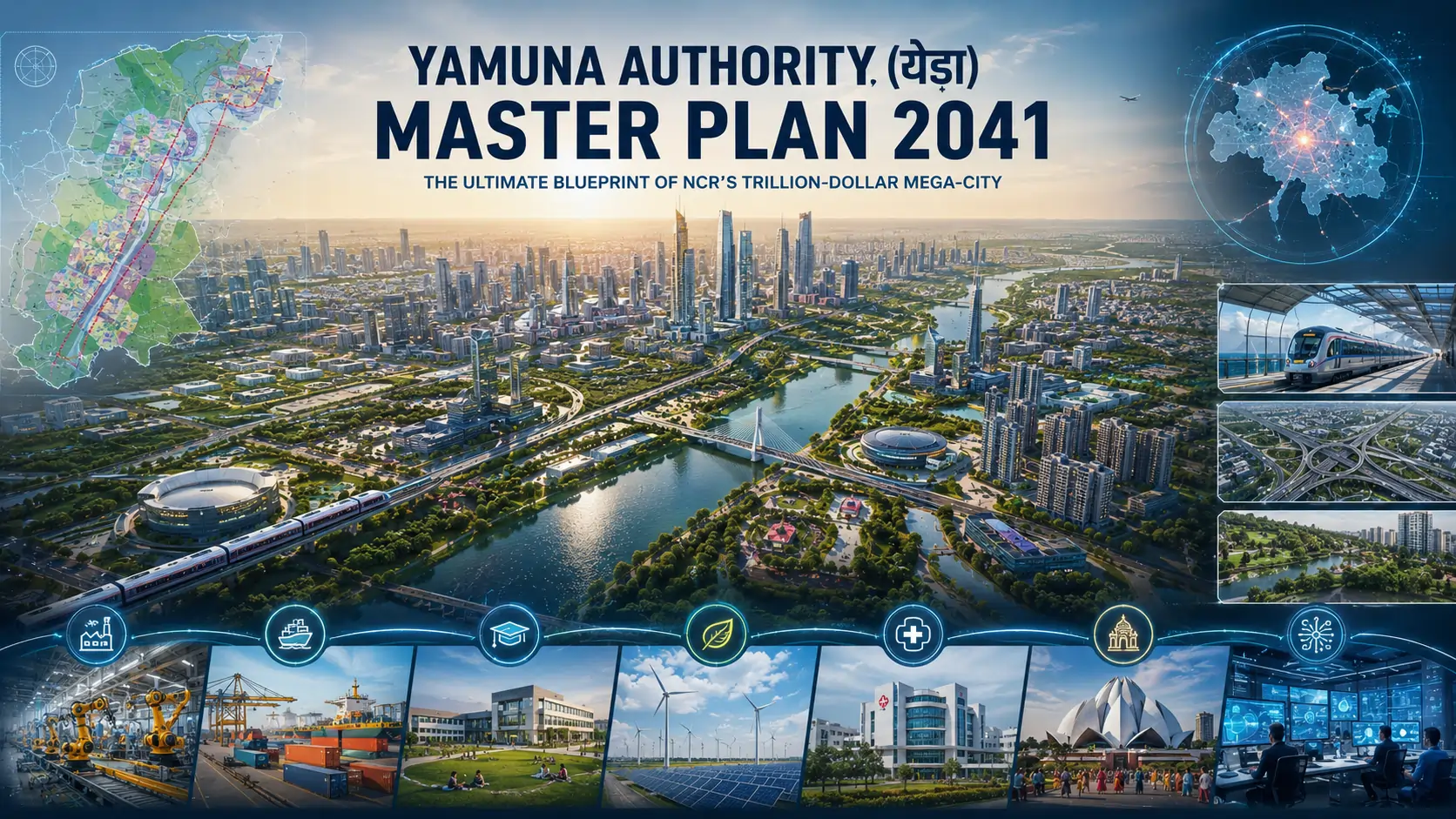
Institutional Dashboard: Core Takeaways
- Master Plan 2041 covers over 3,218 sq km across 6 districts.
- Japan City acts as a dedicated FDI hub near Jewar Airport.
- Aligarh Ring Road via Bhaipur drives new industrial warehousing nodes.
- Aviation safety norms strictly cap commercial building heights locally.
- Hydrogen bus fleets will define zero-emission regional transit loops.
In our market observations over the last decade, few infrastructure narratives have commanded the sheer volume of institutional capital as the ongoing evolution of the National Capital Region (NCR). However, the true epicenter of this wealth generation has unequivocally shifted southeast. The Yamuna Authority (येड़ा) Master Plan 2041 is not merely an urban expansion blueprint; it is the structural reorganization of North India's industrial economy.
As retail investors continue to speculate on immediate residential plot appreciation, savvy institutional funds are quietly executing a completely different strategy. They are mapping out the logistical bottlenecks, industrial corridors, and the highly specialized manufacturing nodes codified deep within the 2041 provisions. To understand where the market is heading, we must dissect how this authority was formed, how it is acquiring land, and the specific megacities it plans to construct over the next two decades.
The Genesis and Evolution of the Yamuna Authority
Established on April 24, 2001, the Yamuna Expressway Industrial Development Authority (originally known as the Taj Expressway Industrial Development Authority) was conceived with a singular vision: to create a high-speed logistical artery connecting the national capital to Agra. However, infrastructure creates its own gravity. What began as a 165 km ribbon of concrete evolved into an administrative behemoth responsible for the planned development of the flanking regions.
Contrarian Market View: The Pricing-In Effect
While the mainstream narrative heavily promotes residential plots near Sector 18 and 20, our data suggests that residential appreciation is heavily "priced in." The true alpha lies in the unglamorous industrial sectors. Based on current institutional capital flows, land allocated for warehousing and green manufacturing will deliver substantially higher long-term rental yields than fragmented residential holdings.
Today, the jurisdiction of येड़ा covers a staggering landbank, stretching across six critical districts of Uttar Pradesh: Gautam Buddha Nagar, Bulandshahr, Aligarh, Hathras, Mathura, and Agra. The foundational logic is simple yet brilliant: utilize the expressway as a spine, and graft massive, specialized economic hubs onto its ribs. For a deeper look at how this compares to other regional developments, you can review our insights on NCR real estate trends.
| Development Phase | Core Infrastructure Focus | Projected Population Density | Economic Driver |
|---|---|---|---|
| Phase 1 (Up to 2026) | Airport Phase 1, Film City Setup, Initial Medical Device Park | ~1.2 Million | Aviation Operations & Media Construction |
| Phase 2 (2026 - 2031) | Japan City, EV Hubs, Rapid Rail Integration | ~2.5 Million | Heavy Manufacturing & FDI Electronics |
| Phase 3 (2031 - 2041) | Aerotropolis Maturation, Complete Agra Connectivity | ~3.8 - 4.1 Million | Global Trade, Tourism & Mega-Logistics |
Master Plan 2041: Engineering the Trillion-Dollar Megacity
The 2041 Master Plan is a radical departure from traditional Indian urban planning. Rather than allowing cities to organically (and chaotically) sprawl outward, the authority is building "cities within cities." The notified area is expected to expand to roughly 3,218 square kilometers. The zoning strategy is ruthlessly efficient, prioritizing industrial output and global trade logistics over dense, unmanageable residential clustering.
A critical component dictating this layout involves the strict aviation safety norms and construction guidelines mandated near the Jewar Airport. The development area is subject to severe height restrictions to prevent radar interference and maintain clear glide paths. This regulatory framework completely alters the commercial skyline; instead of towering skyscrapers, developers are forced to build expansive, low-rise corporate campuses and ultra-wide logistics parks, driving demand for larger land parcels.
The Hub-and-Spoke Micro-Cities
The master plan is delineated into highly specialized sectors. We are observing heavy capital inflows into specific thematic parks. The Medical Device Park in Sector 28 aims to slash India's import dependency, while Sector 29 houses an expansive Apparel Park. However, the crown jewels of this industrial strategy are the foreign direct investment zones.
Focus: Japan City & EV Corridors
The authority is actively developing "Japan City" alongside other specialized industrial manufacturing hubs near the Noida International Airport. Designed to attract semiconductor, electronics, and automotive giants from Tokyo and Osaka, this zone offers plug-and-play infrastructure. Concurrently, massive land tracts are being dedicated to Electric Vehicle (EV) assembly lines and battery manufacturing, heavily subsidized by state initiatives.
To support these massive greenfield developments, transit must be equally modern. As of early 2026, the authority has aggressively pursued the implementation of hydrogen buses and comprehensive electric vehicle transit plans within the region. This zero-emission transit loop will connect the industrial zones directly to the airport terminals, setting a new benchmark for sustainable urban mobility. If you want to understand how transport shifts impact real estate pricing, read our breakdown on infrastructure investment trends.
Logistics and Connectivity: The Aligarh Ring Road Factor
A mega-city cannot survive without fluid logistics. While the main expressway handles passenger traffic, commercial freight requires bypasses. This is where peripheral developments become critical investment targets. Based on recent detailed project reports (DPR), the technical alignment of the upcoming Aligarh Ring Road is set to completely reshape district-level logistics.
Institutional buyers are mapping the specific villages affected by this alignment. Notably, Bhaipur has emerged as a critical node. Positioned strategically along the new logistical routes, land parcels around Bhaipur are rapidly transitioning from agricultural use to prime warehousing and freight-forwarding targets. Investors who understand these micro-geographies, rather than just the macro headlines, will secure the highest returns. For strategies on navigating these large-scale acquisitions, we recommend reading about commercial real estate structures.
Institutional Land Acquisition Process in येड़ा
Zone Identification & Notification
The authority officially notifies agricultural land under specific industrial or commercial zoning laws, activating Section 4 & 6 of the land acquisition acts, permanently halting unauthorized private plotting.
Farmer Compensation & Pooling
State-mandated compensation (often at a premium over circle rates) is dispersed. Under new land-pooling policies, original owners often retain a percentage of developed residential plots to benefit from future appreciation.
Corporate Bidding & E-Auction
Land is not sold to retail buyers. Vast tracts are subdivided into sectors (e.g., Toy Park, EV Hub) and leased to corporate entities via rigorous RERA-compliant e-auctions to ensure capitalization capability.
Deep Dive: Frequently Asked Questions
1. What is the total area covered under the येड़ा Master Plan 2041?
The Master Plan 2041 expands the notified area of the Yamuna Authority to approximately 3,218 square kilometers, extending deep into the Agra district and incorporating massive greenfield urban zones designed for high-density industrial output.
2. Which exact districts fall under the authority's jurisdiction?
The authority covers notified land across six major UP districts: Gautam Buddha Nagar, Bulandshahr, Aligarh, Hathras, Mathura, and Agra, effectively capturing the entire corridor from Delhi-NCR to the Taj Mahal.
3. How is the Aligarh Ring Road impacting local real estate?
The Aligarh Ring Road acts as a crucial logistics bypass. Villages along the alignment, specifically nodes like Bhaipur, are emerging as strategic choke points for warehousing and industrial aggregation due to their direct expressway connectivity.
4. What is "Japan City" in the context of Noida International Airport?
Japan City is a specialized industrial manufacturing hub located near the airport, designed with plug-and-play infrastructure specifically to attract Japanese FDI in electronics, semiconductors, and automotive manufacturing.
5. What are the aviation safety norms for construction near Jewar Airport?
Strict height restrictions and noise attenuation regulations apply. Real estate developers must obtain specific radar and flight-path clearances, ensuring commercial developments remain low-rise, campus-style layouts rather than high-density skyscrapers.
6. When will the hydrogen bus network be operational?
The authority has already initiated plans for hydrogen buses and a comprehensive electric vehicle (EV) transit network, designed to act as the primary, zero-emission mobility backbone connecting the airport to the industrial sectors.
7. Is investing in residential plots better than commercial plots here?
While retail investors flock to residential plots hoping for quick flips, institutional capital is heavily favoring commercial, logistics, and industrial land due to substantially higher, long-term rental yields driven by actual economic activity.
8. How does the Master Plan 2041 address water and drainage?
Learning from the failures of older NCR cities, the plan incorporates advanced nature-based engineering solutions, including extensive bioswale drainage networks to prevent urban flooding and ensure sustainable groundwater recharge.
9. What is the expected population of the region by 2041?
Based on housing allocations and projected industrial job creation, the planned urban centers under the authority's jurisdiction are engineered to support an estimated 3.5 to 4.1 million residents by 2041.
10. What role does Film City play in the regional economy?
Spread over 1,000 acres in Sector 21, the International Film City is designed as a massive media, entertainment, and tourism hub. It is expected to generate massive secondary employment and severely drive up demand for hospitality real estate.
11. Where is the Medical Device Park located?
The Medical Device Park is situated in Sector 28. It acts as a dedicated cluster for healthcare manufacturing, heavily subsidized by state initiatives to reduce India's dependency on imported medical technology.
12. Are there any specific zones for the apparel industry?
Yes, Sector 29 houses a dedicated Apparel Park aimed at centralizing textile manufacturing and exports, deliberately positioned to leverage the rapid air cargo logistics of the nearby international airport.
13. How will rapid connectivity to Central Delhi be managed?
Beyond the Yamuna Expressway, the region will be serviced by Rapid Rail Transit Systems (RRTS) and high-speed metro links, ensuring seamless, under-one-hour connectivity between Central Delhi and the Jewar aviation hub.
14. Can foreign investors buy land directly in this region?
Foreign Direct Investment (FDI) is highly encouraged in industrial and commercial real estate projects. Capital is typically routed through registered Indian corporate entities or JVs in strict compliance with RBI guidelines.
15. What is the status of the Electric Vehicle (EV) manufacturing zones?
Massive land parcels have been formally allocated for EV manufacturing, chassis assembly, and battery production units, aligning with central government PLI schemes to make the region a global EV export hub.
16. How does the authority acquire land for such massive expansion?
Land is acquired through a structured, legal multi-phase process involving direct farmer negotiations, above-market state-mandated compensation packages, and progressive land-pooling policies ensuring rural stakeholders benefit from the development.
Have a story idea, tip, or ask us for any project?
Submit your insights, real estate queries, story ideas, or project inquiries directly to our editorial team using our quick submission form.
Submit Your InquiryLooking for tailored advice?
Get in touch with our experts. We're here to help you navigate your queries and provide the best solutions.