
Noida Real Estate Market Report 2026: Capital Yields, Jewar Airport, & The New Premium Pivot
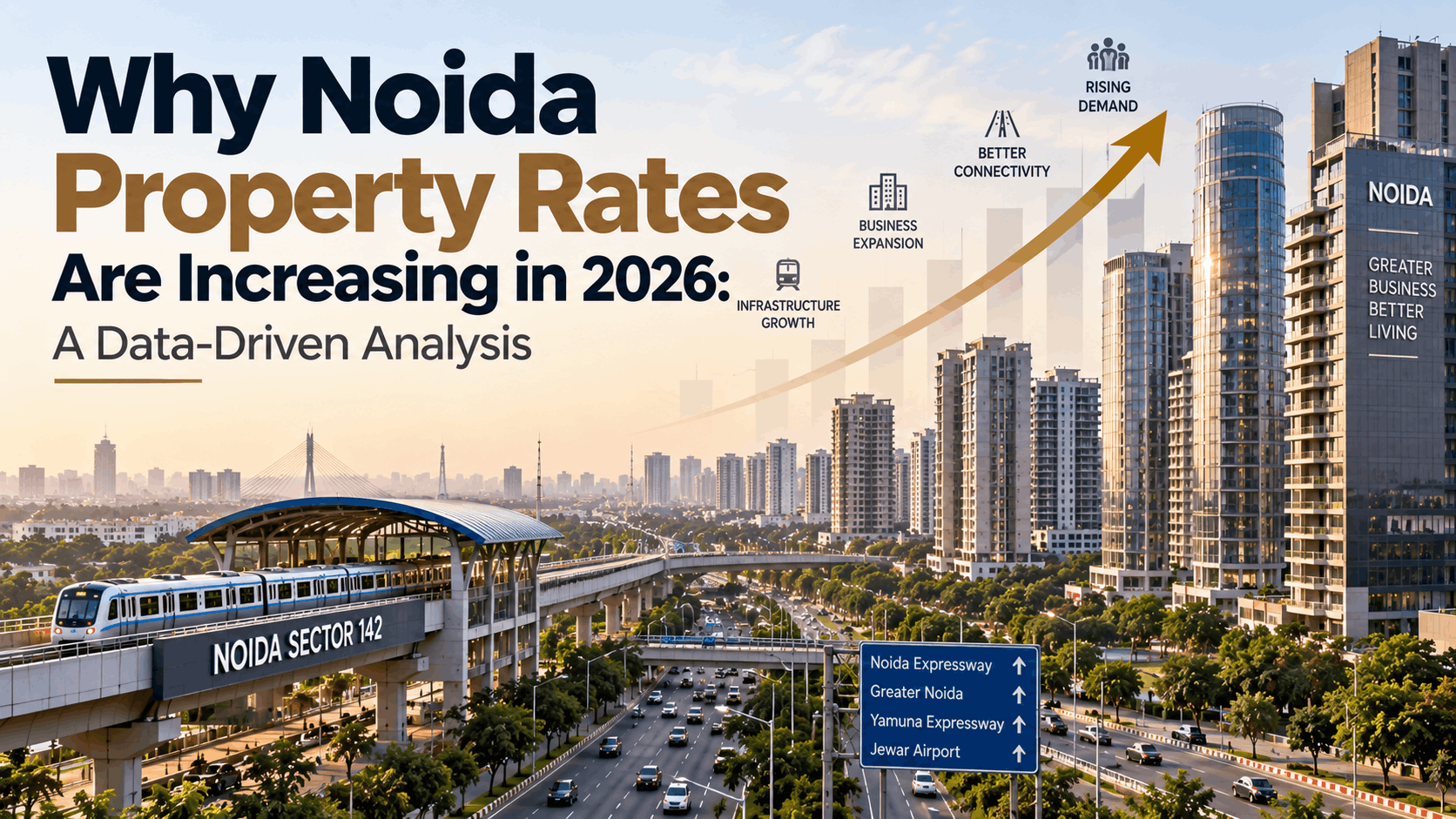
Key Takeaways for Investors
- Average residential rates hit ₹10,780/sq.ft. in 2026.
- Prices reflect a massive 111% surge since 2019.
- Commercial yields in Sector 18 hold firm at 6-7%.
- RRTS alignment guarantees high-speed transit value retention.
- Plots in YEIDA corridors deliver superior long-term capital gains.
In our market observations over the past decade and a half, we rarely witness a structural economic transformation as aggressive and sustained as the current cycle unfolding in Gautam Buddha Nagar. If you were tracking the market back in 2019, you recall an environment suffocated by oversupply, stalled housing projects, and a stagnant residential average of merely ₹4,795 per square foot. Fast forward to 2026, and the landscape is virtually unrecognizable. Driven by massive institutional capital flows, the market has executed a staggering 111% capital appreciation surge.
This is not a speculative bubble fueled by leverage. The price rally we are analyzing today is anchored by tangible, on-the-ground infrastructure delivery. From the operational readiness of the Noida International Airport at Jewar to the rigorous developer purge executed by the Real Estate Regulation and Development Act (UP-RERA), the fundamental risk profile of this micro-market has been completely rewritten.
+111%
Capital Flows
Compliance
Catalyst
Rewritten
Maturity
Market Core Drivers (Interact: Drag or swipe to control the 3D graphic)
The Historical Base: From Industrial Township to RERA Purge
To understand where prices are heading by 2030, we must contextualize the historical baseline. Noida was originally conceptualized in the 1970s strictly as an industrial township designed in a grid-iron pattern to decongest central Delhi. For decades, its vast land banks attracted IT/ITES companies looking for cheaper commercial leases, which inherently necessitated rapid residential development.
However, between 2015 and 2019, the market spiraled into an institutional crisis. Massive developer defaults—most notably the collapse of legacy builders like Jaypee and Amrapali—left hundreds of thousands of buyers trapped in stalled projects. According to official data logged in the UP RERA official portal, consumer confidence was completely shattered. The average rate sat suppressed at ₹4,795 per sq. ft., and rental yields were anemic, hovering around 1.5% to 2% due to crushing oversupply in sectors like Noida Extension (Greater Noida West).
The 2026 Surge and The Contrarian "Reverse Price Anomaly"
Today, the narrative is governed by supply-side quality and infrastructural connectivity. The physical expansion of the Aqua Line Metro has seamlessly bridged the last-mile connectivity gap to the Delhi Metro Blue Line, allowing immediate access to central Delhi. Furthermore, the imminent delivery of the Jewar Airport has transformed early speculative land banking into aggressive, end-user residential demand.
But here is where our current data synthesis uncovers a stark contrarian market view. In standard macroeconomic real estate theory, ready-to-move properties command a premium because they carry zero execution risk. In the 2026 Noida market, we are tracking a blatant Reverse Price Anomaly.
| Asset Readiness | 2019 Average Rate | 2026 Average Rate | Market Insight |
|---|---|---|---|
| Ready-To-Move (Older Stock) | ₹4,795 / sq. ft. | ₹11,706 / sq. ft. | High absorption, but dated layouts limit upside. |
| Under-Construction (Tier-1) | Stalled/Illiquid | ₹12,494 / sq. ft. | Commands a ~6.7% premium over ready inventory. |
| Premium Sector 150 | ₹6,500 / sq. ft. | ₹12,050 - ₹21,000+ | Low-density, ultra-luxury integrated townships. |
Why are buyers willingly paying ₹12,494/sq. ft. for properties that aren't even built yet, versus ₹11,706/sq. ft. for keys they can hold today? Because the current affluent demographic—senior corporate executives, NRIs, and IT professionals—demands a living standard that older stock simply cannot provide. They are paying a premium for modern wellness amenities, IoT-enabled smart homes, electric vehicle charging grids, and the ironclad security of RERA-backed delivery timelines. They refuse to settle for the cramped, mid-segment designs of the past decade.
Commercial Yields & The Logistics Revolution
On the commercial front, Noida has transitioned into a premier corporate powerhouse. Giant tech firms are relocating operations from Gurugram to secure Grade-A office spaces in Sector 62 and retail spaces in Sector 18. This massive influx of white-collar employment has stabilized commercial real estate yields at an incredibly robust 6-7%. With the rise of hybrid workspaces, developers offering flexible, co-working infrastructure with green building certifications are capturing the highest corporate lease rates.
The establishment of the 350-acre Medical Device Park by the Yamuna Expressway Industrial Development Authority (YEIDA) guarantees highly specialized, localized job creation. When you synthesize this with the upcoming 31 km Greenfield Spur connecting Noida directly to the Delhi-Mumbai Expressway, the region is rapidly cementing itself as a global logistics hub.
Investors heavily allocating capital into 100-gaj plots in YEIDA sectors (Sectors 18 and 20) are seeing land rates hit ₹35,000 to ₹45,000 per square meter. Our analysis dictates that, owing to the finite nature of land in these prime logistics zones, residential plots will vastly outperform depreciating apartment structures in pure long-term capital gains over the next decade.
9% - 13%
Risk
Hub
Alignment
FDI Influx
Premium
The 2030 Horizon (Interact: Drag or swipe to control the 3D graphic)
The 2030 Horizon: Mapping the Future of the National Capital Region
Looking ahead to 2030, the macroeconomic indicators point toward sustained, durable growth. The RBI's All-India House Price Index consistently registers upward momentum for Gautam Buddha Nagar . We project the market will exit this phase of rapid 111% spikes and enter a mature stabilization phase characterized by a Compound Annual Growth Rate (CAGR) of 9% to 13%.
The impending high-speed Delhi-Jewar RRTS alignment will systematically erase the distance barrier between central Delhi and the deep suburbs. By reducing commute times to under an hour, properties along this transit corridor will become highly viable for Central Delhi executives, protecting rental yields and driving massive Foreign Direct Investment into the hospitality and warehousing sectors surrounding the airport. However, investors must remain vigilant; keeping an eye on Capital Gains Tax implications will be critical as portfolio values swell over the next five years.
Verify Compliance
Never bypass title checks. Ensure the project is actively registered on the UP-RERA portal with zero pending litigation flags.
Align with Yields
If targeting immediate cash flow, acquire commercial retail or transit-oriented apartments near active Aqua Line stations.
Hold for Equity
For aggressive long-term multiples, secure raw land or plots in the YEIDA sectors directly adjacent to the logistics and aviation hub.
The market in 2026 rewards the informed buyer. Those who blindly speculate on unapproved agricultural land will likely face the same liquidity traps seen in the past decade. But for those who position their capital strategically alongside massive state-backed infrastructural milestones, Noida remains the most potent wealth-creation engine in northern India.
Frequently Asked Questions
What is the current average residential property rate in Noida in 2026?
Direct Answer: In 2026, the average residential rate in Noida has reached ₹10,780 per sq. ft., representing a massive 111% surge since 2019.
Why did early investors choose Noida over Gurugram?
Direct Answer: Historically, astute investors chose Noida for its comparative affordability, master-planned grid-iron road network, superior civic infrastructure, and wider green belts compared to the haphazard urban planning and drainage issues that plagued early Gurugram.
How did RERA implementation change the local real estate trajectory?
Direct Answer: The introduction of UP-RERA purged the market of fly-by-night operators by enforcing strict escrow account maintenance and delivery timelines. This restored buyer confidence and cleared the path for credible Tier-1 national developers to enter.
Which sectors in Noida are currently commanding the highest premium rates?
Direct Answer: Established border sectors (44, 45, and 50) and expansive green corridors like Sector 150 command the highest premiums, currently ranging from ₹12,000 to well over ₹21,000 per sq. ft.
What are the current property rates in affordable zones like Noida Extension?
Direct Answer: Noida Extension (Greater Noida West) remains a relatively budget-friendly hotspot in 2026, with average rates currently ranging between ₹5,000 and ₹10,000 per sq. ft., heavily targeted by young professionals.
How are commercial real estate projects currently performing?
Direct Answer: Commercial office and retail spaces in prime hubs like Sector 18 and Sector 62 are generating highly robust rental yields of 6% to 7%, supported by massive corporate leasing and the rise of hybrid coworking models.
Where are Noida property rates projected to be by 2030?
Direct Answer: Property rates are projected to experience durable, stabilized growth with Compound Annual Growth Rates (CAGR) around 9% to 13%, primarily driven by the full operational scaling and commercial ecosystem maturity surrounding the Jewar Airport.
Will residential plots continue to outperform apartments in long-term appreciation?
Direct Answer: Yes. Due to the finite nature of land in prime infrastructural zones, plots (especially in YEIDA corridors) are mathematically expected to yield higher long-term capital gains than depreciating physical apartment structures.
Have a story idea, tip, or ask us for any project?
Submit your insights, real estate queries, story ideas, or project inquiries directly to our editorial team using our quick submission form.
Submit Your InquiryLooking for tailored advice?
Get in touch with our experts. We're here to help you navigate your queries and provide the best solutions.