
Searchable Human-Optimized Blog Heading:
Executive Summary: Noida Real Estate & History
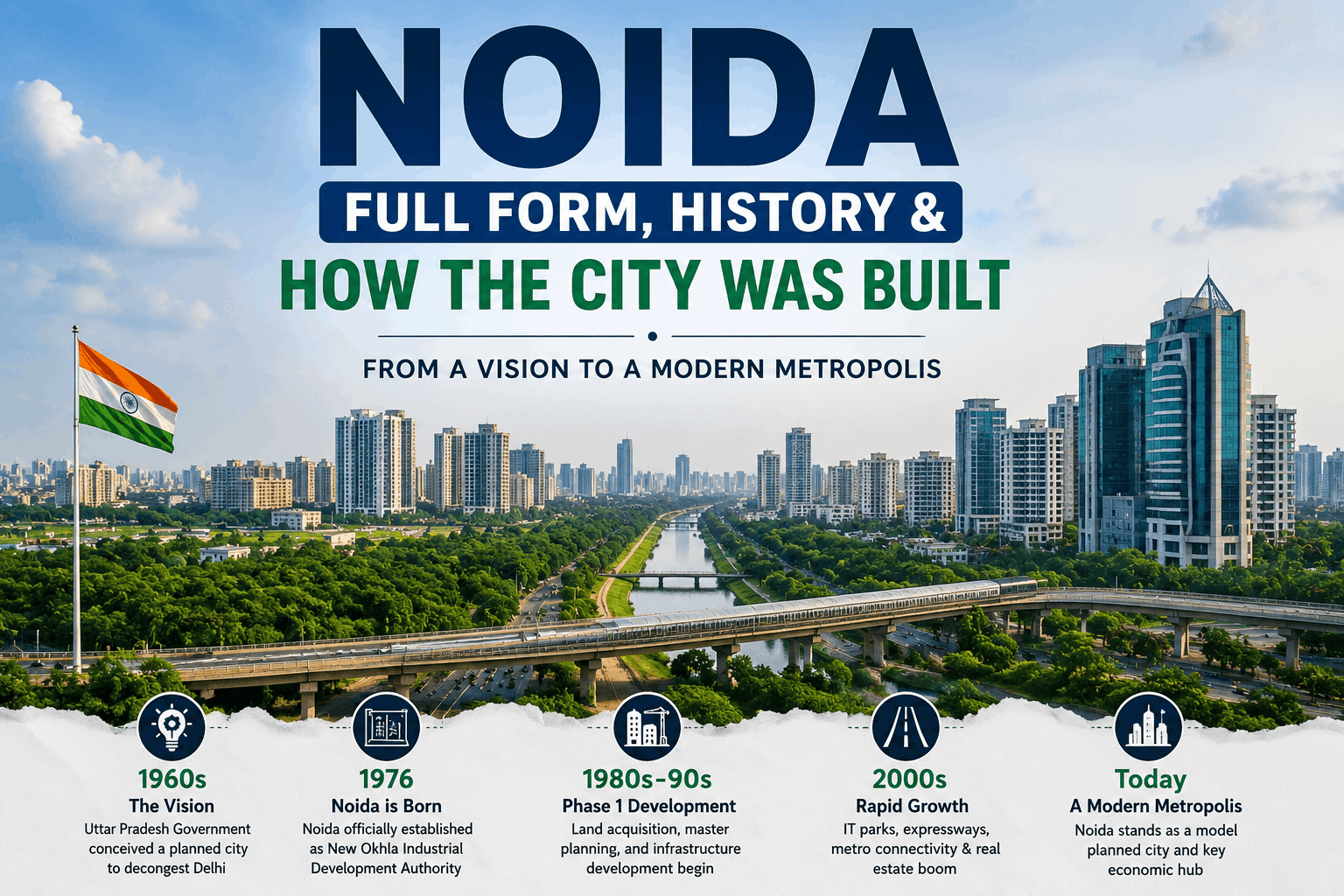
- NOIDA stands for New Okhla Industrial Development Authority.
- Established in 1976 during the Emergency by Sanjay Gandhi.
- Governed entirely by the Authority, not a municipal corporation.
- A premier IT hub contributing nearly 10% to UP’s GDP.
- Greater Noida was built in 1991 to absorb industrial overflow.
If you are navigating the intricate corridors of Indian real estate, understanding the full form of Noida and its master-planned genesis is non-negotiable. Most residents, investors, and even students preparing for competitive exams walk its grid-patterned streets daily without realizing that "Noida" is an acronym, not a traditional city name.
In our market observations over the last 15 years, Noida has transformed from a speculative land acquisition project into a veritable powerhouse of institutional capital. It routinely outpaces regional competitors in FDI absorption and commercial leasing velocity. But to grasp its current financial trajectory, we must dissect how this city was forged out of agricultural dust.
The History: What is the Full Form of Noida?
Every seasoned investor knows that nomenclature often reveals regulatory intent. The acronym stands for New Okhla Industrial Development Authority. Let’s break down exactly what that means structurally.
In the 1970s, the Okhla industrial estate in New Delhi was bursting at the seams. To manage the manufacturing spillover, the government looked across the Yamuna River into the state of Uttar Pradesh. They didn't just build a town; they invoked a specialized act. By establishing an "Authority," the planners circumvented traditional, often sluggish, municipal bureaucracy. Today, this unique administrative structure is precisely why institutional investors prefer building commercial property valuation models here—decisions regarding zoning, infrastructure, and land allocation are handled centrally by one governing body.
When and Why Was Noida Founded?
Noida was officially brought into existence on April 19, 1976. The legal framework supporting this was the Uttar Pradesh Industrial Area Development Act, 1976. The initiative was heavily championed by Sanjay Gandhi during the political era of the Emergency.
The vision was ruthlessly pragmatic: Delhi could no longer handle industrial migration. Uttar Pradesh needed to capture the economic overflow. By acquiring agricultural tracts from roughly 80 surrounding villages, the government laid the blueprint for a master-planned grid. Unlike organic cities that expand haphazardly, Noida was heavily zoned. Industrial sectors were strictly separated from residential zones, flanked by wide arterial roads and green belts. This foundational zoning is what currently commands premium land valuations.
How Noida Was Built: The Master Plan Unveiled
Building India’s premier township required aggressive land acquisition and meticulous engineering. If you look at an early master plan, you will see a fascinating sector numbering system. Sector 1 is nestled right against the Delhi border near the Yamuna River. As you move deeper into Uttar Pradesh, the sector numbers increase.
One of the most profound pieces of trivia—frequently asked in GK quizzes—is the absence of Sector 13. In our market observations, urban planners of the era suffered from triskaidekaphobia (fear of the number 13). They skipped it entirely. You will find a Sector 12 and a Sector 14, but no Sector 13 exists on the map.
The 4 Phases of Infrastructure Maturation
The Manufacturing Phase (1976 - 1990)
Initial land acquisition focused on establishing MSMEs (Micro, Small & Medium Enterprises). Infrastructure was basic, heavily reliant on standard state highways. Residential sectors were built to house blue-collar management.
The Connectivity Catalyst (2001)
The inauguration of the DND Flyway (Delhi-Noida Direct) changed everything. By creating a seamless, toll-based 8-lane expressway connecting South Delhi to Noida, commercial valuations exploded. It signaled to corporate India that Noida was accessible.
The IT & Metro Boom (2006 - 2010)
The arrival of the Delhi Metro Blue Line effectively integrated Noida's workforce with the broader capital region. Simultaneously, the SEZ (Special Economic Zone) policies transformed Sectors like 62, 135, and 142 into massive IT/ITeS outsourcing hubs.
The Expressway Corridor (Present Day)
Development pushed aggressively south along the Noida-Greater Noida Expressway. This area now hosts massive luxury residential condominiums, Grade-A commercial parks, and institutional campuses, driving up per-square-foot yields.
Noida vs Greater Noida: The Origin Story
By the early 1990s, the UP government realized a critical data point: Noida was filling up too fast. The demand for large-scale manufacturing plots could no longer be met within the original master plan boundaries. Hence, in 1991, Greater Noida was carved out as a satellite extension.
While Noida features dense, early-stage urbanization, Greater Noida was planned with the luxury of space. It features broader avenues (up to 130 meters wide), larger sector layouts, and dedicated zones for heavy industries and education (Knowledge Parks). If you are looking to deploy capital, reviewing our comprehensive NCR real estate investment guide will reveal that while Noida offers immediate rental yield stability, Greater Noida offers long-term capital appreciation driven by the upcoming Jewar International Airport.
| Parameter | Noida (New Okhla) | Greater Noida |
|---|---|---|
| Establishment Year | 1976 | 1991 |
| Primary Driver | IT/ITeS, Media (Film City), Startups | Heavy Manufacturing, Education, Data Centers |
| Urban Density | High (Dense Commercial grids) | Low to Medium (Spacious, open planning) |
| Investment Horizon | Stable Yields / Mature Market | Growth Market / High Capital Appreciation |
| Connectivity Anchor | DND Flyway / Blue & Magenta Metro | Yamuna Expressway / Aqua Metro Line |
Noida Today: Economic Facts & Institutional Realities
From an analyst's desk, Noida's macroeconomic contribution is staggering. According to state economic filings, Noida contributes roughly 10% to the total GDP of Uttar Pradesh. It acts as the financial engine for the state, boasting the highest per capita income in UP.
The city's evolution from a factory town to a media and IT juggernaut is complete. It houses the famed "Film City" in Sector 16A, which is the nerve center for India's national news broadcasters. Furthermore, major multinationals like Samsung (which built one of the world's largest mobile manufacturing plants in Sector 81), Microsoft, HCL, and TCS have anchored their massive campuses here.
When analyzing infrastructure growth strategies, we observe that the introduction of UP RERA (Real Estate Regulatory Authority) has heavily sanitized the market. Fly-by-night operators have been purged, leaving institutional developers to consolidate the skyline. Today, if you buy into Noida, you are buying into a regulated, hyper-connected mega-economy.
Frequently Asked Questions
Below, we address the most common queries regarding the history, administration, and real estate fundamentals of the city.
1. What is the exact full form of Noida?
The acronym NOIDA stands for the New Okhla Industrial Development Authority. It represents both the statutory body that manages the region and the name of the city itself.
2. Which state is Noida located in?
Noida is located in the northern Indian state of Uttar Pradesh. Geographically, it sits on the eastern banks of the Yamuna River, bordering New Delhi.
3. Is Noida a part of Delhi?
No, Noida is strictly a part of Uttar Pradesh. However, due to its proximity and economic integration, it is a crucial component of the National Capital Region (NCR).
4. Who founded Noida and in which year?
Noida was officially established on April 19, 1976. The political push to create the city came from Sanjay Gandhi during the Emergency era to manage Delhi's industrial overflow.
5. Why is the extension called Greater Noida?
By 1991, Noida was running out of land for large-scale industrial plots. Greater Noida was established as a planned extension to accommodate this overflow, featuring wider roads and larger sector layouts.
6. How was Noida originally formed?
The UP government acquired agricultural land from around 80 villages near the Okhla border. The land was then master-planned into an industrial and residential grid system by the Authority.
7. Is Noida considered a district?
No. Noida is a statutory authority. The official administrative district that houses Noida, Greater Noida, and the Yamuna Expressway region is Gautam Buddha Nagar.
8. Why does Noida not have a Sector 13?
In a rare case of urban planning superstition, the designers of Noida's master plan skipped Sector 13 due to triskaidekaphobia, the fear of the number 13. The sectors jump directly from 12 to 14.
9. What is the primary economic driver of Noida today?
While originally a manufacturing hub, Noida's modern economy is driven by IT/ITeS outsourcing, media broadcasting (Film City), real estate development, and corporate headquarters.
10. How is Noida connected to New Delhi?
The cities are seamlessly connected via multiple bridges, the most famous being the DND Flyway. Additionally, the Delhi Metro Blue and Magenta lines integrate Noida's workforce directly with the capital.
11. What role does UP RERA play in Noida?
The Uttar Pradesh Real Estate Regulatory Authority (UP RERA) regulates developers in Noida. It enforces transparency, mandates project registration, and provides legal recourse for homebuyers facing delayed possession.
12. Who governs the civic amenities in Noida?
Unlike traditional Indian cities governed by a Municipal Corporation and a Mayor, Noida's water, roads, and civic planning are managed entirely by the CEO and officials of the Noida Authority.
13. How much does Noida contribute to UP's GDP?
The Gautam Buddha Nagar district, anchored primarily by Noida's commercial output, contributes approximately 10% to the total Gross Domestic Product of Uttar Pradesh.
14. What is Noida's Film City?
Located in Sector 16A, Film City is a major media hub sprawling over 100 acres. It houses the headquarters, studios, and broadcasting centers of almost all major Indian national news channels.
15. Is Noida a good place for real estate investment?
Yes. With mature infrastructure, exceptional connectivity to Delhi, regulated development under RERA, and the upcoming Jewar International Airport nearby, Noida offers strong rental yields and steady capital appreciation.
Have a story idea, tip, or ask us for any project?
Submit your insights, real estate queries, story ideas, or project inquiries directly to our editorial team using our quick submission form.
Submit Your InquiryLooking for tailored advice?
Get in touch with our experts. We're here to help you navigate your queries and provide the best solutions.