
Greater Noida West 98% Price Surge: Is Entry Still Justified in 2026?
Key Takeaways: Noida Extension Market 2026
- Prices surged 98% in 5 years, outpacing the NCR average.
- Current base rates range from ₹8,100 to ₹8,700 per sq. ft.
- Growth is shifting from speculative to end-user volume absorption.
- Jewar Airport operational phases anchor long-term structural value.
- Avoid short-term flipping; hold properties for 4 to 6 years.
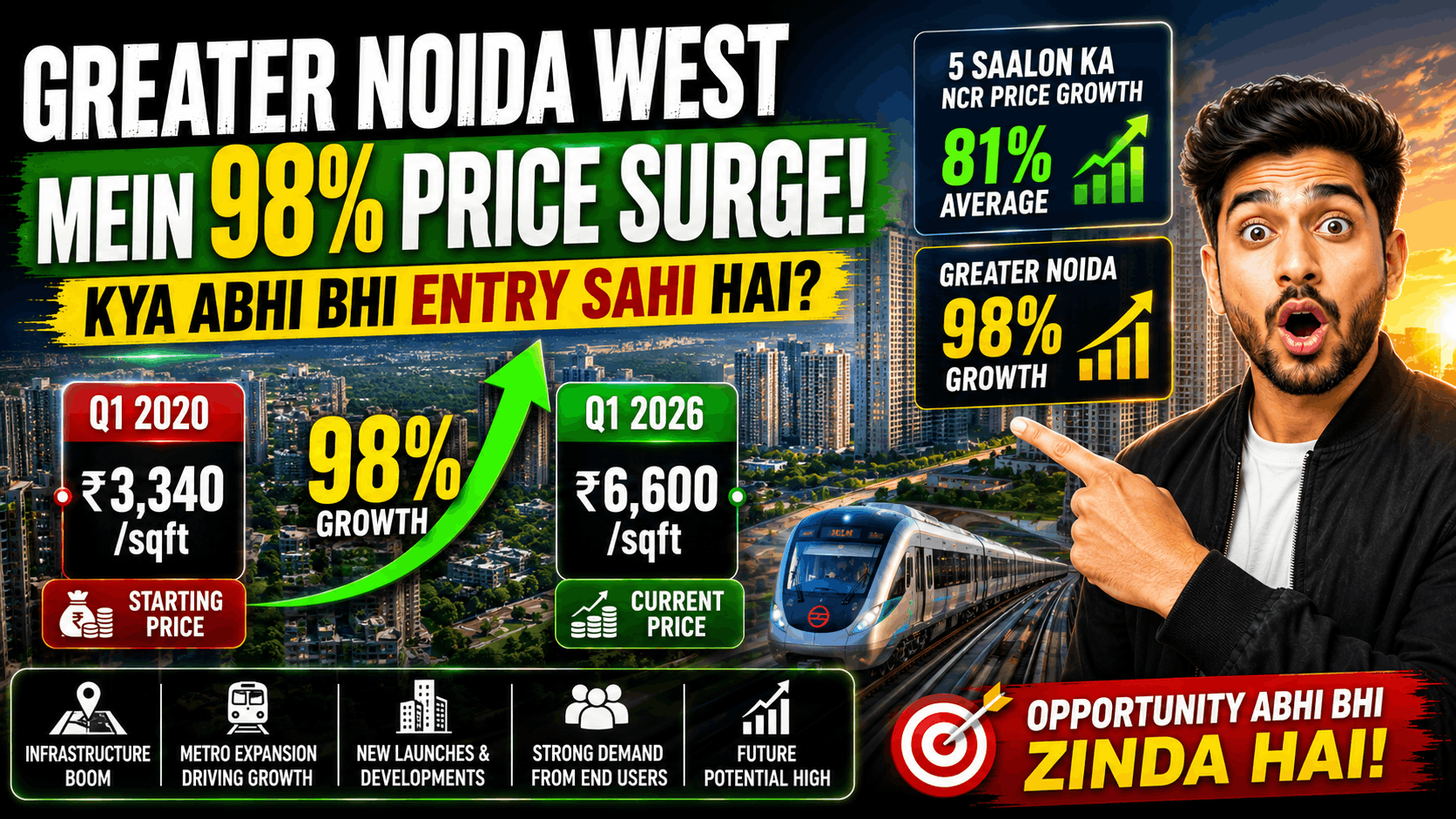
The numbers speak for themselves. If you deployed capital into the Greater Noida West real estate market in Q1 2020, you essentially doubled your money by Q1 2026. A structural shift occurred in the NCR real estate landscape, pushing average prices in Noida Extension from a modest ₹3,340/sq.ft. to an aggressive ₹8,100 - ₹8,700/sq.ft. That is a blistering 98% price appreciation, heavily outperforming the broader NCR average growth of 81%. But here is the critical question institutional investors and retail buyers are asking me today: Is the momentum exhausted, or is this the new pricing floor?
In our market observations, retail investors often suffer from anchoring bias. They look at the 2020 prices, realize they missed the bottom, and assume the current market is dangerously overvalued. This is a flawed metric. To understand where property rates are heading, we must strip away the emotion and analyze hard data regarding capital flows, UP-RERA supply constraints, and raw construction economics.
The Anatomy of the 98% Price Surge
The explosive growth of Greater Noida West wasn't a speculative bubble; it was a violent market correction backed by tangible fundamentals. For years, this micro-market suffered from a severe trust deficit due to delayed projects and aggressive litigation. The implementation of strict RERA guidelines flushed out fly-by-night operators, consolidating land banks into the hands of Grade-A developers with execution bandwidth.
Simultaneously, we witnessed a massive demographic shift. The post-pandemic environment prioritized gated communities, low-density living, and larger floor plates. Central Noida and Gurugram became financially inaccessible for the mid-segment buyer, forcing a massive volume shift toward Noida Extension. This demand collided with surging input costs—cement up 15%, steel up 10%—creating a perfect storm for rapid price inflation. If you want a deep dive on how macroeconomic shifts affect your portfolio, check out our comprehensive mutual fund strategies.
| NCR Real Estate Metric (Q1 2020 to Q1 2026) | Broader NCR Average | Greater Noida West Average |
|---|---|---|
| Capital Appreciation | 81% Growth | 98% Growth |
| Baseline Price (2020) | ₹5,200/sq.ft | ₹3,340/sq.ft |
| Current Valuation (2026) | ₹9,410/sq.ft | ₹8,500/sq.ft |
| Primary Buyer Profile | Investors / Upgraders | End-Users / First-Time Buyers |
Notice how despite the higher percentage growth, Greater Noida West remains cheaper on a per-square-foot basis compared to the NCR average. This remaining price delta is exactly why entry in 2026 is still structurally sound. The market is merely playing catch-up to its intrinsic value.
Debunking the "Market Correction" Myth in Noida Extension
A prevalent contrarian market view circulating among retail buyers is that a 98% run-up guarantees a severe price crash by late 2026. This fundamentally misunderstands how real estate micro-markets operate under high end-user absorption. Speculative markets crash when investors run out of fools to sell to. Noida Extension is not speculative.
Based on current institutional capital flows, the absorption rate for 2BHK and 3BHK units here is largely driven by actual families moving out of rented accommodations in Delhi and East Delhi. When end-users buy, they lock up inventory for 10 to 15 years. They do not panic-sell when interest rates tick up. This heavy end-user base creates a massive support floor under current pricing. You might see price stagnation in isolated, poorly connected sectors, but a macroeconomic collapse of the Noida Extension pricing model is highly improbable.
How to Execute a Safe Entry Strategy in 2026
Buying blind is financial suicide. The era of buying a random plot in Sector 10 and making 50% in two years is permanently over. The market has matured, and your strategy must mature with it. We are entering a phase of micro-market divergence. Premium projects by established builders will continue to appreciate at 8-12% annually, while poorly executed high-density towers will struggle to beat inflation.
If you are deploying capital today, you need to transition your mindset from speculative flipping to long-term wealth compounding. This requires treating real estate like a structured bond. Prioritize ready-to-move-in inventory or properties within 6 months of possession. The minimal premium you pay for immediate possession is an insurance policy against execution risk. For a broader perspective on diversifying your assets, review our breakdown on NCR real estate investment strategies.
Analyze the Developer's Balance Sheet
Do not just look at RERA registration. Verify the developer's delivery track record over the last 5 years. Debt-heavy builders are passing financing costs to buyers, eroding your potential ROI.
Target Low-Density Phasing
High-density projects (more than 100 families per acre) will suffer severe resale bottlenecks by 2030. Pay a premium for low-rise or low-density layouts; they command superior pricing power in secondary markets.
Align with Infrastructure Nodes
Focus your search tightly around the operational nodes of the Aqua Line extension and the FNG expressway intersection. Properties beyond a 15-minute commute to these arteries face growth stagnation.
Navigating Yield vs. Capital Growth
Retail investors consistently confuse rental yield with capital appreciation. Greater Noida West currently offers a rental yield hovering between 2.9% and 4%. While this seems low compared to commercial assets, it is highly competitive for Indian residential real estate. Because the capital values have spiked so aggressively, rental rates take time to catch up. However, the influx of IT professionals seeking affordable housing near Noida's commercial sectors is creating severe upward pressure on rents.
If you are a cash-flow investor, targeting smaller configurations (like large 2BHKs) near Techzone 4 will optimize your yield. If you are chasing absolute capital growth, 3BHK and 4BHK units in Sector 1 are seeing a massive supply crunch, driving premium pricing. Understanding your specific investment mandate is critical before signing a term sheet. Need help structuring your financial goals? Explore our advanced financial planning guide.
Frequently Asked Questions
Is it safe to invest in Greater Noida West in 2026 after the 98% price surge?
Yes, but selectivity is critical. The market has shifted from speculative growth to end-user absorption. Stick to Grade-A developers with clear RERA compliance, as micro-market consolidation is underway.
Why did Greater Noida West property rates surge by 98% between 2020 and 2026?
The surge was driven by aggressive infrastructure delivery (Aqua Line, FNG Expressway), the Jewar Airport cascading effect, a severe post-pandemic supply crunch, and a massive demographic shift toward organized township living.
What is the current average property rate in Greater Noida West in 2026?
As of Q1 2026, the average property rate hovers around ₹8,100 to ₹8,700 per sq. ft. for apartments, up significantly from the ₹3,340 baseline in 2020.
How does Noida Extension compare to Central Noida for investment?
Central Noida is a saturated, ultra-premium market with limited capital appreciation bandwidth. Noida Extension remains volume-driven, offering a lower entry barrier and higher proportional upside.
Will the upcoming Jewar Airport continue to impact Greater Noida West property rates?
Yes. While the initial speculative spike has occurred, the operational phase of Jewar Airport will drive localized commercial demand, shifting the narrative from capital appreciation to higher rental yields.
Are there real risks of a market correction in Greater Noida West?
A severe crash is unlikely due to strong end-user demand. However, we anticipate a price plateau in oversupplied sub-sectors where infrastructure delivery has lagged behind developer promises.
What is the expected rental yield in Greater Noida West for 2026?
Current data indicates an average rental yield of 2.9% to 4% for residential properties, which is highly competitive for the broader NCR market, supported by young IT professionals.
Should I buy a ready-to-move or under-construction flat in Noida Extension?
Ready-to-move properties mitigate execution risk and offer immediate rental yield, making them superior for conservative investors. Under-construction assets only make sense with tier-1 developers and a 5-year horizon.
How has the broader NCR real estate market grown over the last 5 years?
The broader National Capital Region (NCR) saw an average capital appreciation of 81% from 2020 to 2026, driven by a structural shift toward larger homes and institutional capital inflows.
Is Greater Noida West good for first-time homebuyers?
Absolutely. It offers the best price-to-infrastructure ratio in the NCR, providing access to gated communities, modern amenities, and scale without the massive premium of Gurugram or South Delhi.
What are the best sectors to invest in Greater Noida West?
Sector 1, Sector 4, and Techzone 4 are currently outperforming due to superior connectivity, lower density projects, and proximity to upcoming commercial hubs.
Will the Aqua Line metro extension boost Noida Extension prices further?
The metro extension is mostly priced into current valuations. The real catalyst will be the localized micro-economy and last-mile connectivity that develops around the operational stations.
How do construction costs affect Noida Extension property prices?
A 10-15% increase in steel and cement prices, coupled with higher regulatory compliance costs, has established a firm pricing floor. Developers simply cannot launch at 2020 prices anymore.
What is the fundamental difference between Noida and Greater Noida West?
Noida is an established corporate and luxury hub with high ticket sizes. Greater Noida West is a high-density, mid-segment residential engine designed for volume and affordability.
How long should I hold a property in Greater Noida West for maximum ROI?
The era of 1-2 year flipping is over. A minimum holding period of 4 to 6 years is necessary to absorb transaction costs and ride the next wave of infrastructure maturity.
Are low-rise properties a good investment in Noida Extension?
Yes. Post-pandemic preferences have shifted toward low-density living. Low-rise developments command a premium due to scarcity, better land share, and faster execution timelines.
What impact does the RERA act have on Greater Noida West projects?
UP-RERA has forced market consolidation. Fly-by-night operators have been eliminated, reducing supply but radically improving delivery confidence, which structurally supports higher prices.
Are affordable housing options still available in Noida Extension?
True 'affordable' housing under ₹40 Lakhs is virtually extinct. The baseline has shifted, and the new 'affordable' entry point in this micro-market is now between ₹65 Lakhs to ₹85 Lakhs.
Have a story idea, tip, or ask us for any project?
Submit your insights, real estate queries, story ideas, or project inquiries directly to our editorial team using our quick submission form.
Submit Your InquiryLooking for tailored advice?
Get in touch with our experts. We're here to help you navigate your queries and provide the best solutions.