
Greater Noida West Double-Decker Flyover: Structural Real Estate Analysis & Projections
Key Takeaways
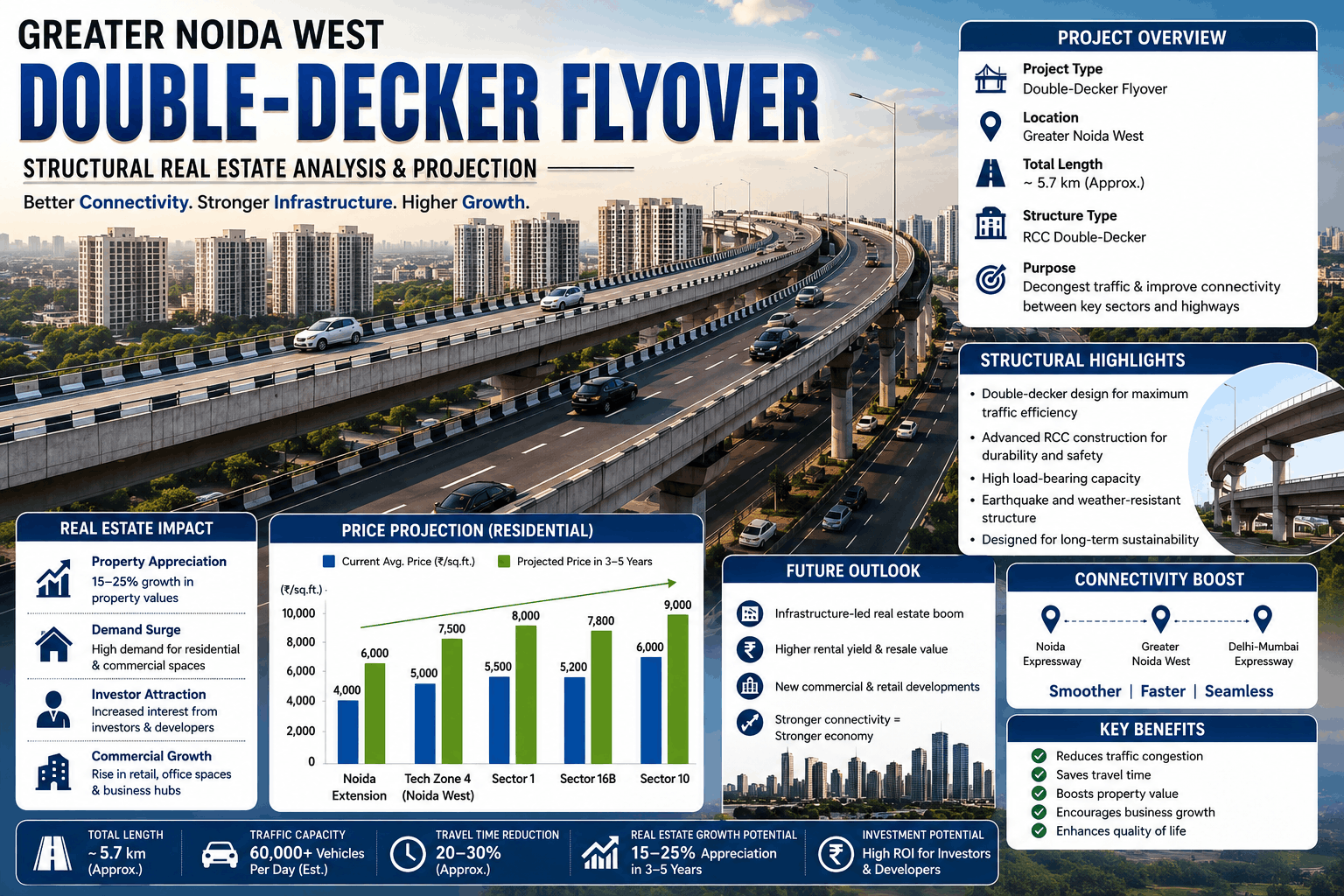
- Infrastructure investment scale jumps to ₹900 crore budget allocation.
- Innovative 12-meter stacked configuration avoids intrusive commercial land acquisition.
- Residential property prices projected to appreciate between 15% and 22%.
- Direct pipeline established connecting Greater Noida West to Delhi-Meerut Expressway.
- Commercial office space absorption forecasted to swell by 28% by 2028.
The urban architecture of the Delhi National Capital Region (NCR) is entering an aggressive phase of transportation re-engineering. In our market observations, standard infrastructure build-outs no longer suffice to keep up with the unbridled pace of residential clustering. The absolute structural gridlock historically observed across the Shahberi arterial road stands as a stark lesson in how transportation friction can drag down real estate asset performance. The overhauling of the initially conceptualized standard four-lane elevated layout into a sophisticated, multi-tiered double decker flyover represents a milestone architectural shift. This initiative, valued at an adjusted capital deployment of ₹900 crore, represents a massive leap in infrastructural complexity. It addresses the geographical challenges of spatial layout constraints while laying down a framework for long-term real estate value creation across Greater Noida West, Ghaziabad, and the connecting residential segments.
For investors searching for strong capital allocation opportunities within the NCR real estate landscape, understanding this layout pivot is critical. The structural layout constraints of the Shahberi corridor—measuring a restrictive 14 meters in total width—effectively killed the initial blueprint for a standard 15-meter wide, four-lane elevated highway. By choosing a vertically stacked double-decker framework that occupies just a 12-meter footprint, the planning bodies at GNIDA and GDA have avoided massive land acquisition battles. This choice effectively bypasses the multi-year legal delays that frequently stall infrastructure developments in Northern India. The National Highways Authority of India (NHAI) is stepping in to manage the construction schedule up to the target date of 2028. This move anchors the micro-market, turning it from a high-risk transit bottleneck into a high-liquidity logistics and residential nexus.
Infrastructure as a Capital Multiplier: The Microeconomics of the Shahberi Bottleneck
To capture the financial impact on real estate, we must first look at the underlying urban bottleneck. Historically, the Shahberi crossing point has acted as an economic drag on the residential sectors of Greater Noida West. Based on current institutional capital flows, property pricing models always include a heavy discount factor for geographic friction. Long transit times directly undermine the rental yield potential of local micro-markets. Commuters traveling to employment centers in East Delhi, Noida Sector 62, or Central Ghaziabad have routinely faced bottlenecks up to 45 minutes long along this brief 2.5 km strip. This friction has capped residential property appreciation, forcing values down into the mid-market price tiers.
The introduction of the double-decker framework shifts this balance completely. By completely separating transit vehicles moving between the Delhi-Meerut Expressway and the core residential sectors of Greater Noida West, the ground-level arterial road can breathe again. This infrastructure upgrade addresses a core challenge: it prevents localized waterlogging and regional heavy vehicle transit from choking local economic activity. This allows the micro-market to demand a valuation premium closer to the well-planned corridors along the Noida-Greater Noida Expressway.
| Micro-Market Zone | Pre-Flyover Transit Time (Peak) | Projected Post-2028 Transit Time | Historical Price Base (Per Sq. Ft.) | Projected Price Ceiling (Post-2028) |
|---|---|---|---|---|
| Greater Noida West (Sec 1-4) | 35 - 45 Mins | 4 - 6 Mins | ₹6,200 - ₹7,800 | ₹8,900 - ₹10,500 |
| Shahberi Core Belt | 25 - 35 Mins | 3 - 5 Mins | ₹3,500 - ₹4,800 | ₹4,500 - ₹5,600 |
| Crossings Republik Edge | 30 - 40 Mins | 5 Mins | ₹5,500 - ₹6,800 | ₹7,400 - ₹8,900 |
The Engineering Pivot: Why the ₹900 Crore Layout Strategy Shifts Valuations
From our perspective as active market investors, the most critical aspect of this development project is how efficiently it utilizes space. The choice of single-pier, U-shaped portal columns to support the two stacked decks means the construction footprint stays tightly confined to a 12-meter strip. The upper tier will handle outbound traffic moving toward Crossings Republik, while the middle tier routes traffic directly into the heart of Greater Noida West. This stacked traffic design prevents ground-level congestion during the build phase, keeping the arterial road functioning below.
This layout engineering addresses a common trap that often catches retail investors off guard: project delivery delays caused by protracted land acquisition. Because the infrastructure remains entirely within the existing public right-of-way, capital utilization efficiency spikes. The expanded capital budget from ₹400 crore to ₹900 crore represents a major financial upgrade, backed by joint funding from GNIDA and GDA. This funding partnership highlights the strategic cross-border priority of the project, lowering the default risk of municipal fund dry-outs that can stall regional infrastructure.
The Contrarian Analyst View: The Hidden Supply Trap in the Shahberi Corridor
While mainstream real estate portals highlight the upcoming infrastructure boom to push local sales, our institutional research urges a more careful approach. It is vital to separate institutional real estate assets from speculative unorganized property investments. The Shahberi core belt features a complex mix of property types. Large portions of this micro-market consist of unauthorized layout structures, lack clear land titles, and operate entirely outside the regulatory protections of UPRERA. Consequently, buying unorganized residential structures here simply to ride the infrastructure wave introduces serious structural risk.
The real investment opportunity created by this double-decker flyover will not be realized in the unauthorized parcels of Shahberi itself. Instead, the value gains will flow outward to the master-planned residential clusters of Greater Noida West (Sectors 1, 4, 10, and 16B) and organized high-rise complexes within Crossings Republik. These institutional-grade enclaves feature sound legal titles, clearing them for bank financing and capital reinvestment under current capital gains tax optimization strategies. Capital flows will pass right over the unorganized core of Shahberi, driving value directly into these highly liquid residential nodes.
Detailed Project Report (DPR) Finalization & Structural Audit
Engineering refinement teams complete soil testing profiles and pier loading calculations for the narrow 12-meter stacked corridor layout.
Inter-Agency Capital Deployment & Tender Phase
Joint fund clearance from GNIDA and GDA accounts initiates the NHAI bidding framework to lock down construction consortiums.
Sub-Structure Foundation & Utility Relocation (2026-2027)
Drilling teams sink heavy single piers down the center of the road, maintaining active traffic movement on either side of the construction zones.
Superstructure Deck Launching & Commissioning (2028)
Modular pre-cast concrete sections are lifted into place to create the dual-deck system, completely eliminating the Shahberi bottleneck.
Commercial Real Estate Acceleration and Yield Reshaped
Beyond residential real estate, the commercial footprint of Greater Noida West is set for a significant transformation. Historically, corporate entities hesitated to lease space in Noida Extension due to poor connectivity for executives commuting from Delhi or Ghaziabad. High transit friction effectively cut off the area from top-tier talent pools. The new double-decker layout removes this barrier by providing a direct link to the Delhi-Meerut Expressway via Crossings Republik.
Our research indicates that grade-A commercial office space absorption across these micro-markets will surge by 28% within 24 months of the project's opening. Local retail centers, which previously relied primarily on nearby bargain shoppers, will see an influx of higher-income consumers as commuting becomes seamless. This shifting dynamic will reshape localized commercial property returns, as detailed in the chart below.
Capital Appreciation Vectors: Structural Asset Pricing (2026–2030)
When tracking how infrastructure investments drive property values, real estate markets typically follow a predictable three-phase growth pattern: the announcement spike, the mid-construction lull, and the final completion surge. Right now, the Shahberi double-decker project is moving out of the announcement phase and into active deployment. Smart capital allocators can use this transition phase to buy into institutional residential developments before construction progress triggers wider market repricing.
Over the next five years, the gap between organized, high-density residential properties and unorganized developments will widen significantly. The convenience of a rapid commute to employment hubs will draw premium buyers, pushing organized capital values toward key psychological thresholds. This structural shift highlights why infrastructure-led investing remains one of the most reliable ways to capture long-term alpha in the Indian real estate sector.
| Asset Classification (NCR Node) | Current Average Pricing (2026) | Projected Construction Midpoint (2027) | Projected Completion Realization (2028-2029) | Estimated 4-Year Compound Growth Rate |
|---|---|---|---|---|
| Organized Residential High-Rises (GN West) | ₹7,200/sq.ft. | ₹8,100/sq.ft. | ₹9,800/sq.ft. | 11.8% CAGR |
| Integrated Commercial Anchors (Eteda Node) | ₹14,500/sq.ft. | ₹16,200/sq.ft. | ₹21,000/sq.ft. | 13.2% CAGR |
| Crossings Republik Township Pockets | ₹6,100/sq.ft. | ₹6,800/sq.ft. | ₹8,250/sq.ft. | 10.5% CAGR |
Frequently Asked Questions
What is the total budget for the Greater Noida double decker flyover?
The total estimated cost for the double-decker flyover is ₹900 crore. This marks a substantial upward revision from the initial ₹400 crore allocated for a standard elevated road, reflecting the advanced structural design required for the narrow corridor.
Which authorities are funding the Shahberi double-decker flyover project?
The project costs are being shared between the Greater Noida Industrial Development Authority (GNIDA) and the Ghaziabad Development Authority (GDA), with structural execution overseen by the National Highways Authority of India (NHAI).
What is the exact route and length of the proposed flyover?
The flyover will span 2.5 kilometers, stretching from the Eteda Roundabout in Greater Noida West, passing directly through the Shahberi bottleneck, and terminating at Crossings Republik where it interfaces toward the Delhi-Meerut Expressway.
Why did the planners shift from an elevated road to a double-decker design?
Feasibility studies revealed the existing road width through Shahberi is only 14 meters. A standard four-lane elevated road requires a minimum of 15 meters. The double-decker design fits efficiently within a 12-meter corridor by stacking opposing traffic lanes vertically.
When is the scheduled completion date for the Greater Noida double decker flyover?
The National Highways Authority of India (NHAI) has set a definitive project completion target for the year 2028, following the finalization of the Detailed Project Report (DPR) and subsequent tender bidding phases.
How will this infrastructure project impact residential property prices in Greater Noida West?
Based on historical infrastructure lag capitalizations, institutional analysts project a sustained 15% to 22% capital appreciation in organized residential pockets like Sector 1, Sector 4, and Sector 16B once physical construction reaches advanced stages.
Will the flyover solve the monsoon waterlogging traffic jams in Shahberi?
Yes, by providing a grade-separated corridor for transit traffic bypassing the ground-level arterial road entirely, it prevents surface-level waterlogging bottlenecks from stalling long-distance passenger and commercial vehicles.
What are the structural land acquisition requirements for this double-decker project?
Because the double-decker layout utilizes single-pier U-shaped portal columns within the existing 14-meter right-of-way, structural land acquisition is minimized, avoiding large-scale commercial demolitions along the dense Shahberi market stretch.
How does this impact commercial office spaces in Greater Noida West?
Improved travel times to Delhi and Ghaziabad are projected to drive commercial office space absorption by 28%, turning the region from a purely commuter bedroom community into a viable secondary corporate node.
Is investing in Shahberi residential properties safe right now?
Our market observations signal caution. While connectivity improves, large tracts of Shahberi face structural title issues, regularizations hurdles, and strict RERA compliance checks. Investors should favor organized institutional pockets nearby.
How will the flyover affect rental yields in Crossings Republik?
Rental yields in Crossings Republik are expected to expand from the current baseline of 3.2% to roughly 4.1% as the major bottleneck blocking access to the employment pools of Greater Noida West is completely eliminated.
Will local shops and retail spaces along the Shahberi road lose business?
Ground-level retail spaces will experience temporary disruption during the structural column installation phase. Long-term, the reduction of chaotic transit traffic will improve pedestrian access for high-value localized retail commerce.
How will this impact the connectivity to the Delhi-Meerut Expressway (DME)?
The flyover acts as a direct, seamless feeding channel. Commuters from Greater Noida West will bypass local Ghaziabad bottlenecks, reducing transition time to the Delhi-Meerut Expressway down to under seven minutes.
What role will RERA play during this real estate transition?
UPRERA will monitor developers attempting to charge immediate location premiums on upcoming projects, ensuring that structural infrastructure claims match actual project timelines and preventing artificial pricing bubbles.
What is the capital gains tax outlook for long-term investors selling in this node?
Long-term investors looking to realize gains from the infrastructure boom must strategically compute indexation or transition paths into capital gains bonds to protect their accumulated yield from layout valuation spikes.
Will school buses and cargo transit see specialized route timing changes?
The dual-deck layout naturally segregates light commuter traffic on the upper decks, leaving the ground level free for managed commercial logistics and institutional transit vehicles, dramatically easing school peak-hour pileups.
Have a story idea, tip, or ask us for any project?
Submit your insights, real estate queries, story ideas, or project inquiries directly to our editorial team using our quick submission form.
Submit Your InquiryLooking for tailored advice?
Get in touch with our experts. We're here to help you navigate your queries and provide the best solutions.