
Dwarka Expressway Real Estate 2026: The ₹6,969 Cr Tunnel & IGI Airport Connectivity Fueling the Boom
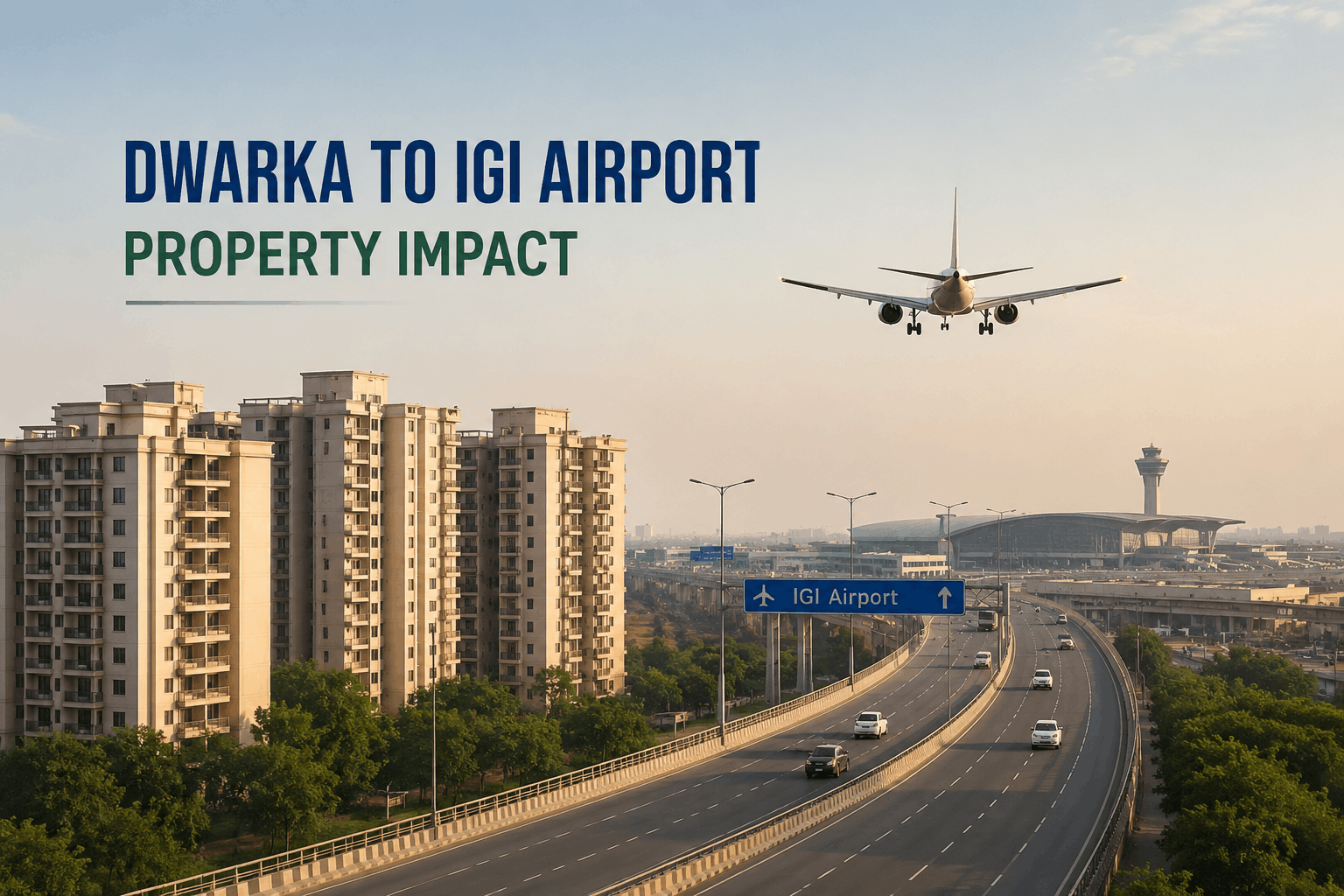
Key Takeaways
- Cabinet approved ₹6,969 Cr tunnel connecting Dwarka Expressway to Vasant Kunj.
- New 3.14-km twin-tube tunnel slashes IGI Airport travel time dramatically.
- Prices doubled from ₹9,434/sqft in 2020 to ₹18,600+/sqft in 2026.
- Grade-A developers dominate the corridor with ultra-luxury integrated real estate.
- Affluent capital pushes middle-class buyers toward deeper New Gurugram markets.
If you track institutional capital flows in northern India, the trajectory of Dwarka Expressway real estate in 2026 offers a textbook study on infrastructure-led asset re-rating. What began as a stalled bypass project decades ago has matured into the most aggressively priced growth corridor in the National Capital Region (NCR). Today, as an active real estate investor, I watch daily as affluent capital abandons congested inner-city grids for the newly operational, signal-free expanse of NH-248BB.
We are witnessing a fundamental geographic shift. The recent Union Cabinet approval of an 8.1-kilometer tunnel connecting the Shiv Murti interchange directly to Vasant Kunj has effectively eradicated the final commuting friction point. Real estate is ultimately a derivative of mobility. When you shrink a volatile 60-minute commute to a predictable 20-minute drive, capital values adjust violently upward.
The Institutional Perspective on Dwarka Expressway Real Estate 2026
Market analysts constantly seek the catalyst that transitions a promising micro-market into a self-sustaining economic ecosystem. For this corridor, the catalyst was federal intervention. By upgrading the road to National Highway status (NH-248BB) in 2016, the NHAI bypassed localized litigation and land acquisition bottlenecks that stranded early developer projects for years.
From Rural Stretch to ₹18,000/sqft: The Historical Transition
A decade ago, peripheral Gurugram sectors traded at a massive "connectivity discount." While mature sectors on Golf Course Road commanded upwards of ₹25,000 per square foot, the Dwarka Expressway languished under ₹10,000. It was entirely car-dependent and lacked the dense population required to support commercial retail.
Early investments were driven almost exclusively by speculative investors and early-stage developers capitalizing on low land costs. They weathered bankruptcies, RERA litigations, and years of stalled construction. Today, the demographic has pivoted completely. The current buyer profile consists of corporate executives, NRIs, and airline professionals seeking seamless access to global transit hubs.
Unpacking the ₹6,969 Crore Vasant Kunj-Shiv Murti Tunnel
In July 2026, the Cabinet Committee on Economic Affairs greenlit a massive 8.1-kilometer road tunnel project connecting NH-248BB to Nelson Mandela Marg. Executed under the Hybrid Annuity Model (HAM), this project is the linchpin of the region's future valuation.
The engineering centerpiece is a 3.14-kilometer twin-tube tunnel constructed using Tunnel Boring Machines. Crucially, nearly 2 kilometers run directly beneath the ecologically sensitive Southern Ridge. By bypassing the Mahipalpur surface gridlock, this infrastructure effectively repositions peripheral Gurugram and Dwarka sectors into the immediate orbit of South Delhi.
Decoding the Real Estate Price Surge
We rely on empirical data to guide **infrastructure investment trends**. From 2020 to 2026, the asset re-rating along this corridor has been historic. Launch prices that hovered around ₹9,434 per square foot during the pandemic have violently corrected upward to reflect the operational reality of the road.
Market Benchmarks: Golf Course Road vs. NH-248BB
Despite the rapid 151% growth trajectory, Dwarka Expressway (averaging ₹12,688/sqft broadly) still trades at a calculated discount to legacy premium hubs like DLF Phases 1-5, which push past ₹25,000–₹45,000/sqft. This specific pricing gap—the "infrastructure maturity spread"—indicates room for further capital appreciation as schools, hospitals, and fine-dining ecosystems catch up with the concrete pouring.
Furthermore, circle rate revisions enacted by state governments acknowledge this ground reality. Sharp upward revisions capture higher stamp duty revenues and officially validate the pricing metrics established by dominant developers. RERA documentation verifies that the supply side has heavily consolidated.
Contrarian View: Is the Mid-Segment Affordability Myth Busted?
A prevalent myth in the NCR property market is that massive infrastructure unlocks affordable housing for the middle class. Our market observations tell the exact opposite story. Massive infrastructure acts as a magnet for high-wealth profiles. The rapid appreciation on the Dwarka Expressway has permanently destroyed the mid-segment affordability narrative for this specific stretch.
Shifting Capital Profiles
As land acquisition costs soar alongside NHAI tunnel developments, Grade-A developers like Sobha, Signature Global, and M3M are forced to build ultra-luxury formats to defend their profit margins. A standard 3BHK that cost ₹1.8 crore in 2022 is actively transacting near the ₹4 crore mark today.
Middle-class buyers are subsequently being pushed outward into tertiary rings. If you want affordability in 2026, you must hunt in deep New Gurugram (Sectors 80-95) or Sohna, relying on arterial highway spurs to bridge the distance back to the economic core.
Real-Time Sector Quoted Rate Matrix 2026
Understanding granular micro-markets is critical for effective **commercial real estate** and residential capital allocation. Sectors like 106 and 111 benefit from hyper-proximity to Delhi and the proposed Diplomatic Enclave, skewing their averages massively upward compared to the southern stretches near Pataudi.
| Micro-Market Node | Market Positioning | Approx. 2026 Quoted Rate (Avg) | Developer Dominance |
|---|---|---|---|
| Sector 111 | Ultra-Luxury / Immediate Delhi Border | ₹15,560 - ₹17,000/sqft | M3M (Elie Saab, Crown) |
| Sector 106 | Luxury / Airport Proximity | ₹14,731 - ₹24,000+/sqft | Sobha, Elan Group |
| Sector 102 & 104 | Premium / Rapid Infrastructure | ₹13,831 - ₹14,563/sqft | Adani Realty, BPTP |
| Sector 37D & 84 | Premium / Emerging Value | ₹10,475 - ₹11,098/sqft | Signature Global, Navraj |
The Future of the IGI Airport Real Estate Corridor (2026-2030)
We are not at the ceiling of this market. Real estate experts and consultancies project a further appreciation of 20% to 60% in capital values by the end of this decade. The integration of UER-II with the Dwarka Expressway transforms this residential belt into a macro-logistics hub.
Execution Strategy for New Entrants
Navigating this mature market requires precision. Speculative bets based purely on road layouts no longer yield the 3x multiples seen between 2020 and 2025. Investors must deploy capital toward execution-proven developers constructing integrated ecosystems.
Analyze RERA Milestones
Avoid developers with high debt leverage or NCLT histories. Premium projects command ₹4–8 per sqft in maintenance. Factor this operational overhead heavily into your net rental yield calculations before executing agreements.
Target Grade-A Commercial Proxies
Invest in residential units located directly opposite upcoming Grade-A office developments along the corridor. The shift from a "bedroom community" to a self-sustaining corporate hub drives sustained high-wage tenant demand.
Map the Tunnel Exits
Capitalize on the specific exit nodes of the new ₹6,969 crore Vasant Kunj tunnel. Proximity to the Shiv Murti interchange will dictate peak valuations for high-wealth expatriate housing over the next four years.
If you are rebalancing your broader **NCR real estate** portfolio, ignoring the compounding effects of the NH-248BB corridor and the Vasant Kunj tunnel is a mathematically flawed strategy.
Frequently Asked Questions
What is the current operational status of the Dwarka Expressway?
The Dwarka Expressway is fully operational in 2026. The 28-kilometer access-controlled highway allows high-speed transit between Gurugram sectors and Dwarka, with active tunnel integrations currently feeding traffic directly to IGI Airport terminals.
What was the original conceptualization of the Dwarka Expressway?
Originally conceived in the late 2000s as the Northern Peripheral Road (NPR), it was designed as an 18-kilometer bypass to connect Dwarka to Gurugram, disperse heavy commercial traffic away from National Highway 48, and open new urban sectors for development.
How have property prices changed on the Dwarka Expressway from 2020 to 2026?
Prices have practically doubled over this timeframe. Average launch prices hovered near Rs 9,434 per square foot in 2020, while 2026 transactional data shows premium sectors averaging Rs 17,000 to over Rs 24,000 per square foot for luxury projects.
What is the new Vasant Kunj-Dwarka Expressway tunnel project?
Recently approved by the Union Cabinet, it is a Rs 6,969 crore, 8.1-kilometer infrastructure project connecting the Shiv Murti Interchange on the Dwarka Expressway directly to Nelson Mandela Marg in Vasant Kunj to decongest South Delhi.
How will the twin-tube tunnel impact travel to IGI Airport?
The engineering centerpiece is a 3.14-kilometer underground twin-tube tunnel running beneath the Southern Ridge. It allows traffic to bypass the notorious Mahipalpur surface gridlock entirely, cutting airport travel times from a volatile 60 minutes down to a predictable 15-25 minutes.
Why was the Dwarka Expressway project delayed historically?
Historically, the project suffered decade-long delays due to complex land acquisition disputes, litigation by local farmers regarding compensation, and severe lack of coordination among conflicting state and central regulatory agencies.
Which real estate developers are currently dominating the Dwarka corridor?
The market has consolidated heavily. Major Grade-A corporate developers like Sobha, Signature Global, Whiteland Corporation, Elan Group, and M3M dominate the skyline, focusing exclusively on ultra-luxury integrated communities.
Which specific Gurugram and Dwarka sectors have the highest current demand?
Gurugram Sectors 106, 111, 113, and 37D, alongside Dwarka Sectors 21-23, are experiencing intense demand. These nodes offer immediate airport proximity and act as the primary interchanges for the new tunnel networks.
How did historical traffic at Mahipalpur affect property values?
Before the tunnels, Mahipalpur acted as a severe geographical barrier. The unpredictable traffic jams deterred affluent homebuyers from moving to peripheral Gurugram, forcing the area to trade at a massive discount compared to inner-city real estate.
How are rising property prices affecting middle-class homebuyers today?
The aggressive asset re-rating has functionally locked middle-class buyers out of the primary NH-248BB corridor. With average ticket sizes breaching Rs 3 crore, mid-income demographics are forced to look at tertiary hubs like deep New Gurugram (Sectors 80-95) or Sohna.
What role does the UER-II currently play in this connectivity web?
The Urban Extension Road-II acts as a force multiplier. By linking the Dwarka Expressway to North Delhi and Haryana, it creates a massive commercial bypass, drawing logistics parks and warehousing demand away from central Delhi streets.
What policy decisions led to NHAI taking over the project?
To shatter state-level bureaucratic deadlocks, the Central Government upgraded the bypass to a National Highway (NH-248BB) in 2016. This empowered the NHAI to deploy federal capital and utilize centralized land acquisition laws to force the project through.
What are the projected property price appreciations for this corridor by 2030?
Institutional analysts and real estate consultancies model a further 20% to 60% appreciation in capital values by 2030, driven by the maturation of commercial office spaces, fine dining, and proposed Metro rail extensions.
Who is driving the current demand for luxury housing near the airport?
The demographic consists of high-wealth profiles, NRIs, multinational corporate executives, and senior airline professionals who prioritize zero-friction global transit, massive smart-home layouts, and elite gated-community amenities.
What are the active operational challenges commuters still face?
While the main carriageways are operational, commuters occasionally navigate localized congestion at key exit ramps. Furthermore, shifting lane closures due to ongoing auxiliary tunnel constructions temporarily disrupt maximum cruising speeds.
How will the corridor compete with emerging hubs like Sohna or Greater Noida?
The Dwarka Expressway operates in the premium, immediate-use segment supported by operational concrete. Conversely, hubs like Sohna and Greater Noida compete heavily on entry-level affordability and speculative long-term land banking potential.
Have a story idea, tip, or ask us for any project?
Submit your insights, real estate queries, story ideas, or project inquiries directly to our editorial team using our quick submission form.
Submit Your InquiryLooking for tailored advice?
Get in touch with our experts. We're here to help you navigate your queries and provide the best solutions.