
Delhi’s Structural Crisis: The Real Estate Reality Behind the Satya Niketan Collapse
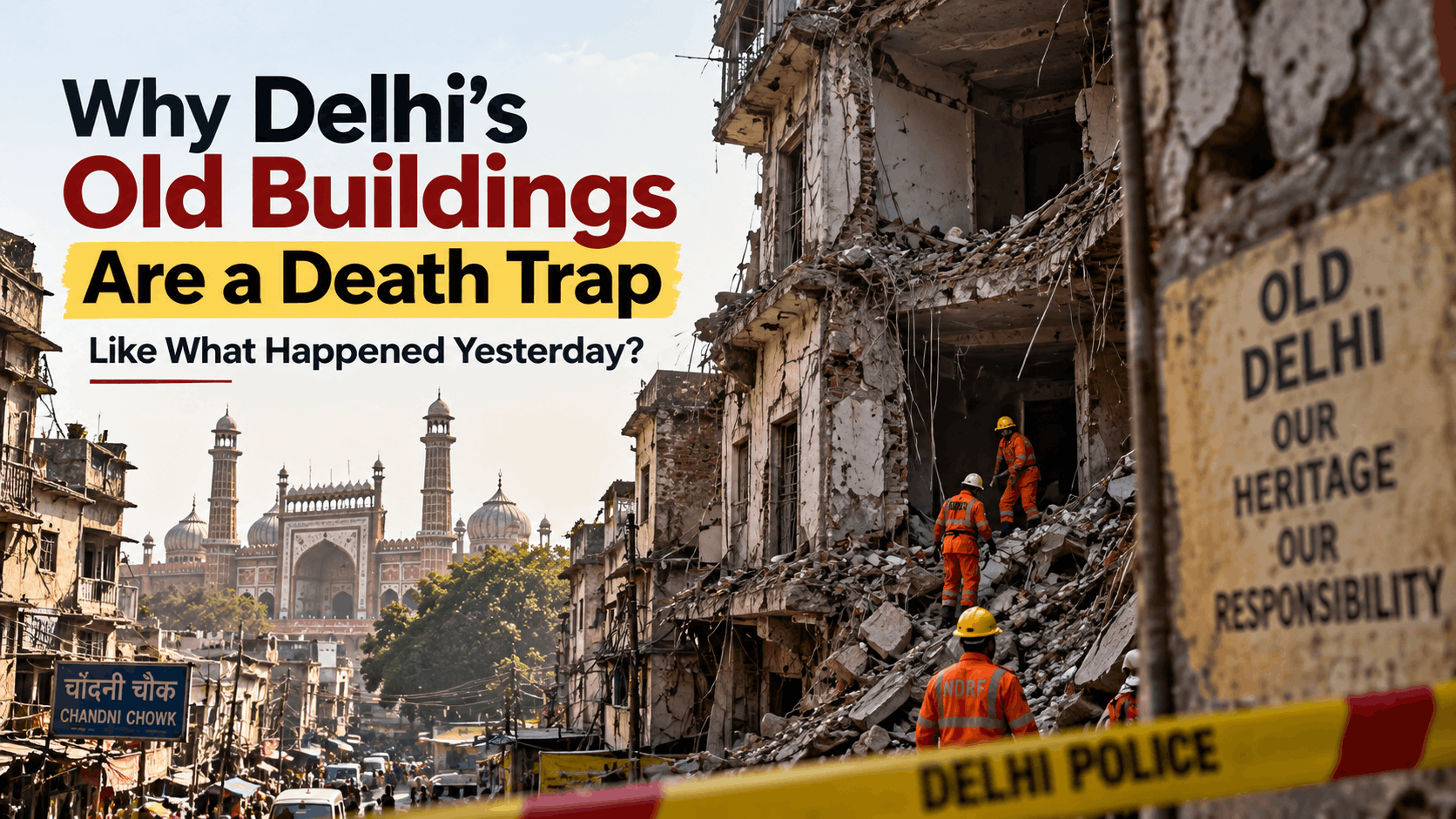
In our market observations over the last fifteen years navigating the National Capital Region (NCR), a terrifying disconnect has emerged between the commercial yield of a property and its underlying physical integrity. On the afternoon of Sunday, September 6, 2026, the devastating collapse of a 50-year-old, five-storey building housing the "Hostel Daze" paying guest (PG) accommodation in Satya Niketan laid bare a brutal reality. Seven lives were lost, and over a dozen occupants were trapped in a disaster that was entirely manufactured by regulatory apathy and unbridled greed.
As active real estate investors, we must acknowledge that this is not an isolated structural anomaly. The NCR's landscape is heavily dotted with structures carrying illegal vertical weight on decaying, unengineered foundations. Today, we are breaking down the geotechnical facts, historical legislative loopholes, and civic failures that make Delhi’s micro-markets a ticking time bomb—and what the transition to formal accountability will look like for capital allocators.
Key Takeaways
- Satya Niketan collapse triggered by illegal basement excavation in aging masonry.
- Historic Lal Dora exemptions allowed unregulated dense village housing developments.
- Delhi's Seismic Zone IV status amplifies the risk of progressive pancake collapses.
- Less than 5% of private 30-year-old properties have undergone structural audits.
- Future laws will impose personal criminal liability on colluding municipal engineers.
The Genesis of Delhi's Unengineered Real Estate
To understand why a building in a prime South Campus artery folds like a house of cards, we must look at the capital's aggressive post-colonial urbanization. Following the 1947 Partition, Delhi’s population doubled within a single decade. The state’s priority was rapid refugee rehabilitation, not geotechnical longevity. Emergency settlements in micro-markets like Lajpat Nagar, Patel Nagar, and Kingsway Camp were erected utilizing affordable load-bearing brickwork, unwashed river sand, and low-grade mortar.
Speed and cost completely sidelined structural surveying. These early structures lacked the seismic dampening and continuous load paths required for high-density, multi-storey living. Over subsequent decades, as single-family ownership transitioned into collaboration agreements with informal private developers, these initial single-storey units were repeatedly built upon. Second, third, and fourth floors were arbitrarily stacked without expanding or strengthening the original foundational footprint.
The Contrarian Market View: Most retail investors assume property value in South Delhi hubs strictly correlates to location and FAR (Floor Area Ratio). In reality, purchasing a builder floor constructed pre-2010 on an unreinforced footing represents a massive unpriced liability. The structural depreciation outpaces the land appreciation.
The Loophole of Lal Dora and Municipal Amnesties
A significant catalyst in this unchecked growth was the historical exemption of urban villages. In 1908, British cartographers outlined village habitations with a red thread on revenue maps—the Lal Dora—exempting them from standard municipal layout sanctions. Post-independence, Section 347 of the Delhi Municipal Corporation Act inadvertently preserved these exemptions to respect indigenous village governance.
As Delhi University expanded and the metro network grew, commercial developers heavily exploited this loophole. They erected multi-storey tenements over unregulated micro-plots without securing professional engineering oversight. Compounding this, the recurring regularization of unauthorized colonies via the National Capital Territory of Delhi Laws (Special Provisions) Acts normalized non-compliance. Property owners learned that unauthorized vertical extensions would eventually be pardoned by executive order, bypassing the need for rigorous, non-destructive structural integrity tests.
Interactive Model: The Anatomy of Vertical Overload
This visual demonstrates how illegal upper floors apply lethal compressive force to historic masonry foundations.
Drag to Rotate: The red layer represents an unapproved, structurally fatal 5th-floor addition on an aging brick foundation.
The Satya Niketan Tragedy: A Predictable Pancake Collapse
What specific sequence of structural failure triggered the fatal collapse on September 6, 2026? Preliminary findings confirm that the owners of the "Hostel Daze" PG were executing unauthorized basement and ground-floor modifications. In highly congested student hubs like Satya Niketan, Mukherjee Nagar, and Kalu Sarai, ground-floor square footage yields exceptional commercial rental income.
Landlords are deeply incentivized to expand basements or remove load-bearing partition walls to accommodate dining halls. Securing formal municipal permissions requires architectural drawings and structural certificates—certifications these aging structures would systematically fail. Consequently, owners deploy informal daily-wage laborers to conduct structural alterations behind closed tarpaulins.
When you compromise a critical masonry wall in an old building—lacking continuous reinforced concrete frames (columns and beams)—the lack of load paths causes an immediate downward crush. In Satya Niketan, the removal of load-bearing supports abruptly transferred immense vertical weight onto deteriorated masonry, crushing the upper floors down onto one another in a textbook pancake structural failure.
Structural Mechanics: Engineered vs. Unreinforced Real Estate
To grasp the severity of the crisis, we must differentiate between historic masonry and modern engineering. Unreinforced masonry buildings rely entirely on thick, compressive brick walls and lime-surkhi mortar to transfer gravity loads straight down. Conversely, modern reinforced cement concrete (RCC) utilizes interconnected beams, columns, and steel rebar to resist bending, tension, and lateral shear forces.
| Structural Attribute | Historic Unreinforced Masonry (Pre-1990) | Modern Engineered RCC Framework |
|---|---|---|
| Load Distribution | Gravity transferred directly through compressive brick walls. | Loads travel continuously through interconnected slabs, beams, and columns. |
| Seismic Ductility | Extremely low; crumbles under horizontal shear stress. | High; steel rebar allows bending and deformation without collapse. |
| Foundation Tolerance | Shallow brick-strip footings; fails rapidly if soil saturates. | Deep pile or raft foundations capable of bridging soil settling. |
| Modification Risk | Fatal. Removing a wall removes primary structural support. | Moderate. Infill walls can be altered without dropping the building. |
Seismic Zone IV: The Catalyst for Catastrophe
Delhi is geographically situated in Seismic Zone IV (Severe Intensity), exposing it to tectonic stresses from both the Himalayan arc and local faultlines like the Mahendragarh-Dehradun Fault. The National Disaster Management Authority (NDMA) has repeatedly warned that the capital's unreinforced masonry lacks ductility—the ability to deform under horizontal ground movement without fracturing.
If a magnitude 6.5+ earthquake strikes the NCR, geotechnical models indicate ground accelerations would far exceed the capacity of these structures. Because buildings in dense settlements like Chandni Chowk and urbanized villages share common party walls and lack reinforced tie-beams, an earthquake could trigger domino-style progressive collapses across entire blocks.
Data aggregated from independent municipal housing surveys and student union audits.
The Regulatory Enforcement Paralysis
Following the catastrophic 2010 Lalita Park building collapse in East Delhi (which claimed 71 lives), sweeping structural health audits were promised for all pre-1980 buildings. The Justice Shamit Mukherjee Commission uncovered severe systemic failures, forged clearances, and unheeded complaints. Yet, the directives stalled within municipal red tape.
The core issue lies in Sections 348 and 349 of the DMC Act. If a building is deemed hazardous, the Municipal Corporation of Delhi (MCD) commissioner must issue an official show-cause notice. The owner is granted an administrative window to appeal to the Appellate Tribunal for MCD (ATMCD), which frequently grants interim stays. Even if demolition is ordered, coordinating with the local police for security forces creates a multi-agency friction that routinely delays physical action until the building self-destructs.
Interactive Model: Subsoil & Foundation Integrity
Decades of subterranean water seepage chemically erodes the mortar in deep brick foundations.
Drag to Inspect: Saturated Yamuna alluvium reduces soil shear strength, triggering rapid foundational shifting.
The Future Outlook: Accountability and Technological Oversight
The Satya Niketan collapse has triggered unprecedented legal action. Delhi Police immediately registered an FIR under Bharatiya Nyaya Sanhita (BNS) Sections 105 (culpable homicide not amounting to murder) and 125(a) (act endangering life). The immediate suspension of the South Zone Deputy Commissioner and multiple junior engineers signals a shift. The judiciary is likely moving to establish personal financial liability and non-bailable criminal culpability for municipal engineers who turn a blind eye to illegal commercial operations in exchange for graft.
Looking ahead, technological integration will be mandatory. We anticipate the deployment of satellite Synthetic Aperture Radar interferometry (InSAR) and drone-mounted LiDAR to detect millimeter-scale structural settlement across dense neighborhoods. Furthermore, integrating property tax IDs with a public GIS-based building safety portal could mandate dynamic QR-code-based structural safety certificates at every building entrance. Tenants could instantly scan these markers to verify engineering clearance before signing a lease, starving unsafe operators of tenant revenues.
Until institutional redevelopment and land pooling schemes can successfully replace these dense urban villages with seismically engineered housing blocks, real estate capital must tread carefully. The days of bypassing structural integrity for blind commercial yield are coming to a catastrophic end.
Frequently Asked Questions
What caused the Satya Niketan building collapse on September 6, 2026?
Direct Answer: The collapse was triggered by unauthorized basement and ground-floor repair work actively underway on a 50-year-old, five-storey building. Removing load-bearing structural elements abruptly transferred immense vertical weight onto deteriorated masonry, causing a sudden pancake collapse.
Why are multi-storey buildings in Delhi's Lal Dora areas structurally vulnerable?
Direct Answer: Lal Dora areas (historical urban villages) were exempted from standard municipal building bylaws. Developers heavily exploited this loophole to construct multi-storey commercial and residential structures over tiny plots without securing professional structural engineering oversight or foundational testing.
How does Delhi's placement in Seismic Zone IV affect its older real estate?
Direct Answer: Delhi is situated in Seismic Zone IV (Severe Intensity). Unreinforced brick-and-mortar buildings lack the ductility provided by modern steel rebar. During moderate earthquakes, these rigid, top-heavy structures are highly susceptible to lateral shear forces, risking domino-style collapses.
What is the legal process for the MCD to demolish a dangerous building?
Direct Answer: Under Sections 348 and 349 of the DMC Act, the MCD must issue a show-cause notice, grant the owner an appeal window (often resulting in tribunal stays), and secure police protection. This multi-agency coordination routinely delays physical enforcement.
Are there mandatory structural safety audits for private properties in Delhi?
Direct Answer: Although legally and judicially expected following major disasters, real-world compliance is virtually non-existent. Less than 5% of private residential structures exceeding 30 years have completed a formal, non-destructive structural safety audit (such as rebound hammer tests).
What role does monsoon waterlogging play in Delhi's building collapses?
Direct Answer: Inadequate stormwater infrastructure allows heavy monsoon rains to pool around unsealed foundations. This constant subterranean seepage saturates shallow subsoils, leaches lime mortar, and severely erodes the load-bearing capacity of aged brick footings.
What criminal charges apply to landlords of collapsed buildings?
Direct Answer: Recently, the Delhi Police have utilized Bharatiya Nyaya Sanhita (BNS) provisions, booking owners under Sections 105 (culpable homicide not amounting to murder) and 125(a) (endangering public safety) for operating commercial housing in structurally condemned conditions.
How will third-party structural engineering audits improve the system?
Direct Answer: Transitioning inspection authority from potentially corrupt municipal field inspectors to accredited independent structural engineering firms—backed by mandatory professional indemnity insurance—would align incentives directly with rigorous engineering compliance rather than localized graft.
Have a story idea, tip, or ask us for any project?
Submit your insights, real estate queries, story ideas, or project inquiries directly to our editorial team using our quick submission form.
Submit Your InquiryLooking for tailored advice?
Get in touch with our experts. We're here to help you navigate your queries and provide the best solutions.