
Delhi-Meerut RRTS Real Estate Impact: The 2026 Namo Bharat Investment Playbook
Key Takeaways
- Ghaziabad real estate surged 131% tracking RRTS deployment milestones.
- Meerut land rates jumped to ₹20,000/sq yard via robust TOD zoning.
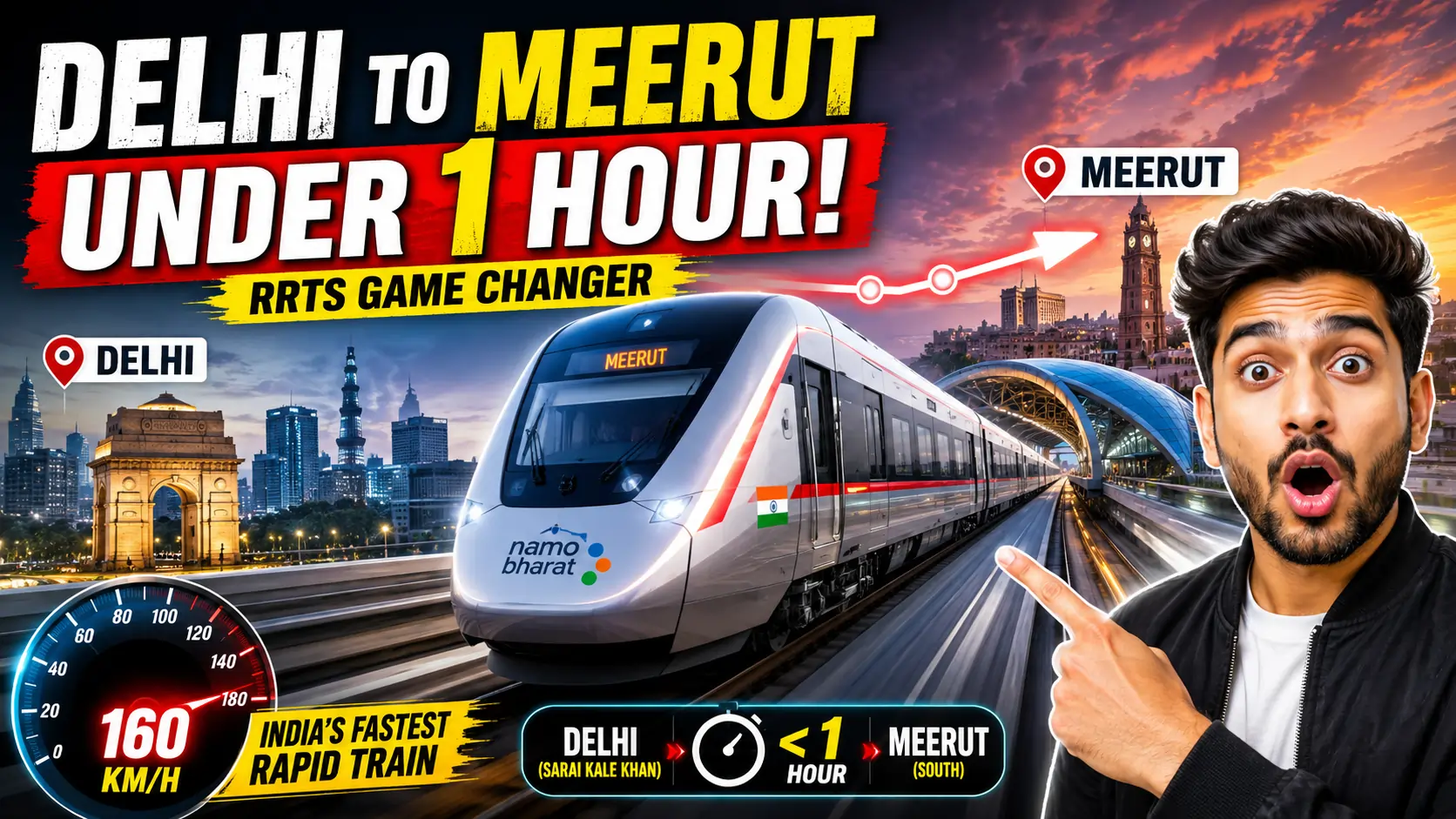
- Namo Bharat trains reduce Delhi-Meerut commute to under 60 minutes.
- Smart investors target Zone 2 radii to capture unpriced FAR potential.
- Full 82-km operationalization achieved ahead of major Q3 2026 economic shifts.
In our market observations over the past 15 years, true infrastructural alpha is rarely broadcasted; it is systematically built. The completion of the 82.15-km Delhi Meerut RRTS corridor in early 2026 fundamentally shattered the traditional geographic boundaries of the National Capital Region (NCR). Institutional capital is no longer evaluating Meerut as a distant tier-2 agrarian outpost. The deployment of the Namo Bharat trainsets operating at 160 km/h has catalyzed a structural re-rating of the entire western Uttar Pradesh real estate ecosystem.
Operating out of Greater Noida, we track capital velocity daily. When a government executes a ₹30,274 crore mass transit pipeline that genuinely alters the distance-to-time ratio, smart money shifts aggressively. We are witnessing a textbook execution of Transit-Oriented Development (TOD), effectively transforming dormant land parcels into vertical, high-density economic engines. Let us dissect exactly how this corridor is rewriting the **NCR real estate** playbook.
The Namo Bharat Revolution: Redefining NCR Economics
Retail buyers often make the critical error of valuing real estate purely on spatial distance from Central Business Districts (CBDs). Institutional investors, however, price assets based on transit friction. Prior to the full operation of the Delhi Meerut RRTS, commuting between Meerut and central Delhi was an exhausting 2.5-hour ordeal plagued by severe highway congestion. Today, tapping an NCMC card allows a professional to traverse that exact corridor in under 60 minutes.
This friction elimination has birthed the "reverse migration" phenomenon. Highly paid tech, finance, and corporate executives are abandoning the hyper-inflated, congested micro-markets of South Delhi and Gurugram. Instead, they are locking in premium, mid-rise gated communities in Ghaziabad and Meerut at a fraction of the cost, utilizing the RRTS as a high-speed umbilical cord to their offices.
Institutional Real Estate Impact
Data from tier-1 developers and the UP RERA dashboard explicitly confirms an aggressive bull run. The narrative is backed by hard numbers. Ghaziabad localities, specifically around the Sahibabad and Duhai nodes, registered an astonishing 131% capital appreciation over the last four years. The market did not gradually tick upwards; it repriced violently as NCRTC hit critical construction milestones.
| Micro-Market Node | 2022 Average Rate (per sq. ft) | Current 2026 Rate (per sq. ft) | Net Appreciation | Primary Catalyst |
|---|---|---|---|---|
| Ghaziabad (Core) | ₹4,500 - ₹5,200 | ₹7,500 - ₹12,000 | +131% | Intermodal Integration (Metro + RRTS) |
| Indirapuram / Sahibabad | ₹5,500 - ₹6,800 | ₹9,000 - ₹13,000 | +73% | Expressway + Sahibabad RRTS Hub |
| Meerut South | ₹2,800 - ₹3,500 | ₹4,500 - ₹6,500 | +54% | Namo Bharat Operational Launch |
| Modipuram / Shatabdi Nagar | ₹2,200 - ₹3,100 | ₹3,500 - ₹5,000 | +40% | TOD Zoning & Greenfield Developments |
Decoding the Transit-Oriented Development (TOD) Masterplan
Amateur speculators buy land; professional investors buy zoning. The secret sauce of the Delhi Meerut RRTS is not the train itself—it is the state-backed legislative framework accompanying it. **Transit-Oriented Development (TOD)** policy essentially allows developers to construct dramatically taller, denser buildings in specific radii around transit stations.
The Meerut Development Authority (MDA) executed a masterstroke by delineating 3,273 hectares of land exclusively for TOD zones within its 2031 Master Plan. This unlocks premium Floor Area Ratio (FAR) limits, transforming horizontal sprawl into highly profitable, mixed-use vertical nodes integrating retail, commercial offices, and luxury residential apartments.
The Strategic Investment Playbook Along the Corridor
If you are consulting a **property investment guide**, generic advice no longer applies to this micro-market. You must execute a sniper-like approach based on specific station nodes and their designated economic function within the broader NCR blueprint.
Target the Interchange Hubs for Commercial Yields
Stations like Sarai Kale Khan, Anand Vihar, and Ghaziabad are Multi-Modal Integration (MMI) hubs where the Delhi Metro, Indian Railways, and ISBT converge. Commercial real estate (retail and office spaces) within a 500-meter radius here commands massive rental premiums due to guaranteed, unceasing footfall.
Secure Plotted Developments in Emerging Meerut Corridors
For capital appreciation plays, focus on Shatabdi Nagar and Partapur. Top-tier branded developers (e.g., Prestige Group, Paras Buildtech) have already launched gated plotted townships here. The entry price is relatively lower, but the infrastructure-led upside over a 5-year hold period is immense.
Verify RERA & Land Use Compliance Strictly
Rapidly developing corridors naturally attract illicit land subdivisions. Ensure any plot or apartment you acquire is strictly UP-RERA registered and falls explicitly within the legally sanctioned TOD zones delineated by the Meerut Development Authority.
Future Nodes & Regional Integration Expansion
The National Capital Region Transport Corporation (NCRTC) views the 82-km operational stretch not as a terminus, but as a foundation. Strategic planning is already in advanced phases to extend this exact rapid rail line through Muzaffarnagar, culminating in Haridwar. This will effectively bind the industrial clusters of western UP with major spiritual and tourism hubs, creating an economic corridor unparalleled in northern India.
Real estate markets are forward-looking mechanisms. The sheer existence of the Namo Bharat project has de-risked investments in Tier-2 UP cities. The infrastructure deficit has been permanently erased, replaced by world-class, interoperable ETCS L2/L3 signalling systems and automated fare collections.
Frequently Asked Questions
What is the current operational status of the Delhi-Meerut RRTS in 2026?
According to NCRTC, as of February 2026, the entire 82.15-km corridor from Sarai Kale Khan in Delhi to Modipuram in Meerut is fully operational, eliminating partial stretch delays and handling high-frequency commuter traffic.
How has the RRTS impacted real estate prices in Ghaziabad?
Since the project's inception and subsequent phased rollouts, Ghaziabad properties have seen massive revaluation, with certain micro-markets witnessing an aggregate price appreciation of up to 131% over the last four years.
What is Transit-Oriented Development (TOD) in the context of the Namo Bharat project?
TOD is a specialized urban planning model allowing significantly higher Floor Area Ratios (FAR) and mixed land-use near RRTS stations. This incentivizes developers to build high-density residential and commercial hubs within walking distance of transit.
How much time does it take to travel from Delhi to Meerut via the RRTS?
Operating at average speeds of 100 km/h and maximums of 160 km/h, the Namo Bharat trains allow commuters to cover the distance between Sarai Kale Khan (Delhi) and Meerut in under 60 minutes.
Are there dedicated zones for commercial real estate development along the corridor?
Yes. Specifically, the Meerut Master Plan 2031 has officially delineated over 3,273 hectares of land as dedicated TOD zones meant for commercial, retail, and dense residential exploitation.
Which areas in Meerut have seen the highest property price appreciation?
Nodes like Modipuram, Partapur, and Shatabdi Nagar have witnessed land rate appreciations from ₹8,000–12,000 per sq yard up to ₹20,000 per sq yard, registering growth between 30% to 54%.
How does the RRTS integrate with the existing Delhi Metro network?
The system utilizes Multi-Modal Integration (MMI). Stations like Anand Vihar, New Ashok Nagar, and Sarai Kale Khan are directly connected to Delhi Metro lines, ISBTs, and Railway Stations via integrated concourses and Foot Over Bridges (FOBs).
What is the ticket price structure for the Delhi-Meerut RRTS?
Fares operate on a distance-based matrix. The base fare starts at ₹20 for 0-2 km and scales upwards. Premium coach access requires double-tapping at specific platform AFC gates and incurs a higher fee.
Is the Meerut Metro connected to the RRTS network?
Yes. The corridor represents a unique hybrid model where the inter-city RRTS infrastructure is seamlessly shared with the local intra-city Meerut Metro services, dramatically reducing localized capital expenditure.
What are the upcoming extensions planned for the Namo Bharat corridor?
The NCR Planning Board has drafted preliminary expansions to stretch the existing Meerut corridor northbound towards Muzaffarnagar and eventually Haridwar, further integrating the state's economic map.
How does the National Common Mobility Card (NCMC) work on the RRTS?
Commuters do not need separate paper tickets; any RuPay standard NCMC card can be tapped directly at the automated fare collection gates, instantly debiting the exact distance-based fare upon exit.
Why is 'reverse migration' occurring from Delhi to Meerut?
With commute friction removed, professionals are opting out of Delhi's high housing costs and congestion, choosing to purchase spacious premium apartments in Meerut and commuting back to the capital in under an hour.
What facilities are available in the Premium Coach of the RRTS?
The premium segment offers enhanced commuter luxury, including plush reclining seating, dedicated magazine holders, coat hooks, exclusive platform lounge access, and enhanced legroom for corporate travelers.
What makes investing in land near RRTS stations highly lucrative yet risky?
While the capital upside triggered by TOD rezoning is immense, retail investors face extreme risks involving unverified rural land titles, shifting zoning laws, and aggressive speculation. Professional due diligence is mandatory.
How does the speed of the Namo Bharat train compare to standard metro systems?
Standard urban metro systems operate at an average speed of 30 km/h with stations every 1-2 km. The RRTS is an inter-regional rail operating at an average of 100 km/h with stations spaced 5-10 km apart.
Have a story idea, tip, or ask us for any project?
Submit your insights, real estate queries, story ideas, or project inquiries directly to our editorial team using our quick submission form.
Submit Your InquiryLooking for tailored advice?
Get in touch with our experts. We're here to help you navigate your queries and provide the best solutions.