
DDA Housing Scheme Narela 2026: The 25% Discount & FCFS Reality Check
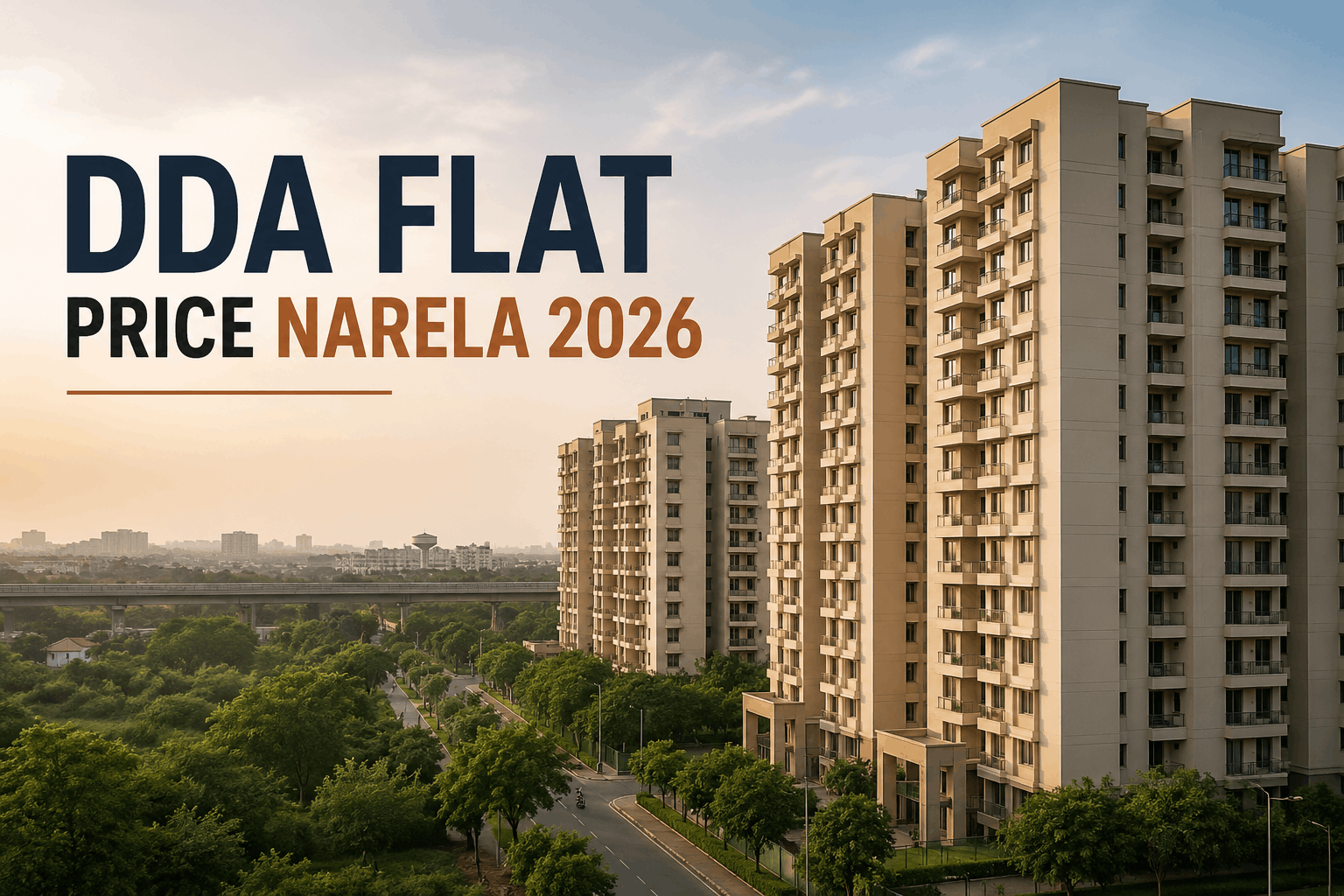
Key Takeaways: DDA Narela Schemes
- Karmajeevi and Nagrik schemes offer flat 25% discounts on properties.
- Digital First-Come-First-Served booking completely replaces the lottery.
- MIG properties start at ₹73 Lakh, HIG at ₹96.86 Lakh.
- Rithala-Narela-Kundli Metro will fundamentally boost future capital values.
- Private professionals are now eligible, bypassing older government restrictions.
In our market observations as institutional real estate analysts, the Delhi Development Authority (DDA) has historically been a sluggish behemoth, clinging to rigid cost-plus pricing models and lottery-based allocations that frustrated middle-class homebuyers. For years, Narela remained the ultimate casualty of this strategy—a micro-market suffering from delayed infrastructure and immense unsold inventory. However, the launch of the DDA Housing Scheme Narela 2026 marks a ruthless, highly pragmatic paradigm shift.
By implementing a flat 25% discount on the disposal cost and shifting entirely to a digital First-Come-First-Served (FCFS) model, the DDA is liquidating "dead" housing stock to fund rapid infrastructure execution. For retail investors and homebuyers in Delhi NCR, this creates a distinct arbitrage opportunity. Before the Rithala-Narela-Kundli Metro corridor becomes fully operational, capital assets are available at a steep concession. Let us break down the underlying financial mechanics of the Karmajeevi Awaas Yojana and Nagrik Awaas Yojana to see if deploying capital here aligns with your wealth-building strategy.
The E-Commerce Era of DDA: FCFS vs. The Old Lottery System
The defining feature of the 2026 schemes isn't just the price tag; it is the absolute destruction of the lottery allocation model. Historically, if an applicant wanted a DDA flat, they subjected themselves to a randomized draw. A buyer working in South Delhi might arbitrarily "win" a top-floor flat in Narela, completely misaligned with their family's logistical needs. This mismatch caused unprecedented surrender rates.
Today, the DDA operates more like an e-commerce platform. Under the FCFS mechanism, prospective buyers log into the DDA Awaas portal, view active inventory in real-time down to the pocket and floor number, and immediately "lock" the asset by paying an earnest deposit online. This eliminates allocation uncertainty and empowers buyers to strategically select units that maximize natural light, ventilation, and park-facing premium positioning.
Decoding Karmajeevi Awaas Yojana & Nagrik Awaas Yojana 2026
To flood the zone with liquidity and clear inventory, the DDA segmented its marketing into two massive, overlapping initiatives targeting distinct psychographics and income brackets.
Karmajeevi Awaas Yojana: Opening the Doors to Professionals
Launched with much fanfare in July 2026, this scheme was a breakthrough. Previously, subsidized properties were heavily gated for standard government employees. The Karmajeevi mandate explicitly opened eligibility to corporate executives, registered journalists, doctors, and legal professionals. It initially released over 1,224 flats (1, 2, and 3 BHK) in Sector A1-A4, providing these high-earning demographics a safe, litigation-free asset to park capital.
Nagrik Awaas Yojana: Expanding the MIG and HIG Footprint
Witnessing the overwhelming response to the initial discounts, the DDA augmented their offerings in August 2026. The Nagrik Awaas Yojana dumped an additional 1,183 to 1,287 Middle Income Group (MIG) and High Income Group (HIG) flats onto the FCFS portal, situated in Pockets 3 and 4 of Sector A1-A4. This move directly targets established families seeking spatial upgrades (3 BHKs offering 160-186 sq meters) without paying the bloated premiums demanded by private developers in Gurgaon or Noida.
Narela Flats Pricing Breakdown (After 25% Discount)
Transparency in disposal pricing is the DDA's current strongest advantage over private developers, who frequently manipulate base rates to simulate "discounts." The 25% cut here is applied to fixed, audited land and construction valuations. Let's analyze the current capital requirement matrix for the Sector A1-A4 pockets.
| Flat Configuration | Approx. Plinth Area (sqm) | Post-Discount Price Range | Booking Amount (FCFS) |
|---|---|---|---|
| 1 BHK (LIG/EWS Type) | 33 - 61 sqm | ₹15 Lakh - ₹33.66 Lakh | ₹50,000 / ₹1,00,000 |
| 2 BHK (MIG) | 126 - 140 sqm | ₹73.02 Lakh - ₹83.58 Lakh | ₹4,00,000 |
| 3 BHK (HIG) | 164 - 186 sqm | ₹96.86 Lakh - ₹1.19 Crore | ₹10,00,000 |
*Note: Exact pricing depends on the specific floor, pocket, and corner configurations dynamically updated on the DDA Awaas portal. Prices reflect current market listings as of Q3 2026.
The Contrarian Market View: Why Smart Money is Buying "Ghost Towns"
Mainstream retail buyers often scoff at Narela, labeling it an underdeveloped "ghost town" compared to the saturated, hyper-expensive micro-markets of South Delhi or Dwarka. However, institutional investors operate on the "Arbitrage of Time."
Dwarka and Rohini were once considered unlivable peripheral outposts. Those who purchased DDA assets there prior to the Metro expansion saw exponential wealth generation. If you wait until a micro-market is fully gentrified with running Metros, functioning malls, and manicured parks, you are buying at a 40% to 50% premium. You are paying for the convenience of the present, rather than investing in the growth of the future. The 25% discount is effectively the DDA compensating you for bearing the current infrastructural inconvenience.
Infrastructure Catalysts: Metro, RRTS, and UER-II
A 25% discount on a depreciating asset is a value trap. But Narela is not depreciating; it is on the verge of a massive municipal cash injection. The government is aggressively pivoting Narela from an industrial suburb into a primary residential and educational node.
The primary driver is the sanctioned Rithala-Narela-Kundli Metro corridor. Once the Red Line extension is operational, commute times to central employment hubs will collapse, fundamentally altering the demographic that can live in Narela. Furthermore, the integration with the Urban Extension Road-II (UER-II) creates seamless connectivity to the IGI Airport and NH-44, completely bypassing the notorious Delhi traffic. For buyers looking at a 5-to-10-year horizon, these infrastructure nodes guarantee capital appreciation that outpaces the standard inflation metric. When liquidating assets later, you must understand your tax liabilities; consult our updated breakdown on the **capital gains tax** framework for property sales.
Step-by-Step Workflow: How to Book a DDA Flat on the Awaas Portal
The digital pivot means speed is critical. Desirable ground-floor and park-facing units in Pockets 3 and 4 are secured within minutes of the inventory going live.
Registration & KYC
Navigate to the official DDA Awaas portal (eservices.dda.org.in). Create an account using your PAN, Aadhaar, and mobile number. Pay the non-refundable one-time ₹2,500 registration fee to activate your dashboard.
Live Inventory Selection
Under your dashboard, select the specific scheme (Karmajeevi or Nagrik). Filter by sector (e.g., A1-A4), pocket, and configuration. Browse the live layout map to select your exact unit.
The 15-Minute Lock Window
Once you click a flat, you are granted a 15-minute exclusivity window. The flat is temporarily removed from the public pool. You must immediately pay the booking amount (₹4 Lakh for MIG, ₹10 Lakh for HIG) via net banking or UPI.
Demand Letter & Final Financing
Upon successful payment, an automated demand-cum-allotment letter is generated. You generally have 90 days to arrange a home loan and remit the remaining 75% balance (adjusted for the booking amount) to execute the final freehold registry.
Real Estate Economics: Should You Wait for the Metro?
Retail investors consistently ask if they should wait until the civil construction of the Metro is visible. Financially, this is a flawed strategy. Real estate markets price in future events long before they happen. By the time Metro pillars are erected in Narela, the DDA will pull the 25% discount, and secondary market sellers will immediately hike their asking prices by 30%.
Acquiring a 3 BHK HIG flat today for roughly ₹96 Lakh secures an asset that, based on historical Delhi property cycles, will command upwards of ₹1.5 Crore to ₹1.8 Crore upon transit maturation. Furthermore, for investors looking at the LIG and EWS segments (priced between ₹15 Lakh to ₹22 Lakh), the planned establishment of seven university campuses will create a massive, captive student demographic, driving rental yields to highly lucrative levels. For deeper insights into managing cash flows in burgeoning property markets, review our comprehensive coverage on **NCR real estate** dynamics.
Frequently Asked Questions: Narela DDA Schemes 2026
1. What is the DDA Karmajeevi Awaas Yojana 2026?
The Karmajeevi Awaas Yojana is a targeted housing initiative offering a flat 25% discount on over 1,224 ready-to-move 1, 2, and 3 BHK flats in Narela. It explicitly opens eligibility to corporate professionals, doctors, and journalists, replacing the older government-only lottery systems with a digital FCFS model.
2. How is the Nagrik Awaas Yojana 2026 different from Karmajeevi?
While the Karmajeevi scheme initially targeted specific professional classes, the Nagrik Awaas Yojana is a broader civilian scheme. In August 2026, it was expanded to include an additional 1,183 to 1,287 MIG and HIG flats in Narela’s Sector A1-A4 (Pockets 3 and 4), also offering the aggressive 25% discount to the general public.
3. What is the starting price of a DDA flat in Narela under these schemes?
Prices are highly competitive. After the 25% discount is applied to the disposal cost, an entry-level 1 BHK flat starts at approximately ₹33.40 Lakh. The 2 BHK MIG flats begin around ₹73.02 Lakh, and the spacious 3 BHK HIG flats range from ₹96.86 Lakh to roughly ₹1.19 Crore.
4. What is the booking amount required for MIG and HIG flats?
To secure a flat online during the First-Come-First-Served window, you must pay an upfront booking amount. This is ₹50,000 for a 1 BHK, ₹4,00,000 for a 2 BHK (MIG), and ₹10,00,000 for a 3 BHK (HIG) flat. This earnest money is subsequently deducted from your total final payment.
5. How does the DDA First-Come-First-Served (FCFS) system actually work?
The FCFS model acts like an e-commerce checkout. You log into the DDA Awaas portal, select the specific flat you want (including the floor and block), and are granted a 15-minute lock window to pay the booking amount. This guarantees the flat is yours, entirely eliminating the randomness of the old lottery draw.
6. Is Metro connectivity currently available for Narela flats?
Direct Metro access is not currently operational, which is the primary reason for the historical discount. However, the approved Rithala-Narela-Kundli Metro corridor is under active development. This upcoming connectivity is the major catalyst projected to drive massive capital appreciation for early buyers.
7. Are there maintenance issues with vacant DDA flats in Narela?
Because flats sat vacant for years under inefficient older schemes, minor wear occurred. To combat this, the DDA has recently issued multi-crore renovation tenders specifically to repair and upgrade older vacant LIG inventory in Sectors G-2 and G-6, ensuring habitability prior to handover.
8. Can I combine two adjacent DDA flats in Narela?
Yes. The DDA has reformed its strictly rigid structural guidelines. To appeal to larger modern families who found LIG or MIG sizes restrictive, buyers are now officially permitted to amalgamate (join) two adjacent flats to form a single, expansive residential unit.
9. Can private sector employees apply for these discounted schemes?
Absolutely. The 2026 schemes represent a monumental shift. The Karmajeevi and Nagrik schemes explicitly cater to private corporate employees, registered self-employed professionals, doctors, and legal experts, removing the exclusionary barriers that previously blocked private wealth from entering DDA properties.
10. Is there a restriction on owning property in Delhi if I want to apply?
It depends on the scheme iteration. The Karmajeevi Awaas Yojana generally waived the restriction, allowing existing property owners to apply. However, standard conditions under the broader Nagrik Awaas Yojana stipulate that the applicant or their immediate family must not own a pucca residential property in Delhi. Check specific brochure terms before registering.
11. Are the Narela flats freehold or leasehold properties?
The units allocated under the DDA 2026 Karmajeevi and Nagrik schemes are sold as freehold properties. This means you hold absolute ownership over the property and a proportionate share of the underlying land, significantly boosting your ability to secure bank loans and execute future resale transactions easily.
12. What happens if I delay the final payment after booking a flat?
Once you pay the booking amount and the demand letter is generated, you typically have a 90-day window to secure a mortgage and pay the balance. Delays will attract a penalty interest rate defined by the DDA. Prolonged failure to pay will result in the automatic cancellation of the allotment and forfeiture of your initial booking deposit.
13. What major infrastructure developments are planned near Sector A1-A4?
Narela is transitioning into a mega-hub. Beyond the Metro extension, the state government is pushing the development of an extensive educational hub featuring seven university campuses. Additionally, integration with the Urban Extension Road-II (UER-II) will dramatically reduce commute times to the airport and Gurgaon.
14. How does the DDA 25% discount compare to private builder "offers"?
Private developers frequently inflate their base square-foot price before offering temporary "festival discounts," creating a false sense of value. The DDA's 25% discount is applied directly against the rigidly audited, government-sanctioned disposal cost, making it a genuine capital reduction on ready-to-move, zero-risk inventory.
15. What are the long-term investment prospects for Narela real estate?
Currently, Narela is a buyer's market heavily subsidized by the DDA's discount phase. However, as the Rithala-Narela-Kundli Metro and institutional hubs materialize, it will shift rapidly to a seller's market. Institutional modeling suggests capital appreciation yields of 8-12% annually as the infrastructure vacuum is filled over the next 5 to 7 years.
16. Are there any special concessions for Persons with Benchmark Disabilities (PwBD)?
Yes, the DDA provides substantial support for PwBD applicants. They receive an additional 5% rebate on the disposal price (subject to a ₹1 lakh cap). Crucially, they can opt for a Hire Purchase model, paying just 25% upfront and the remainder via 15-year monthly installments at a 10% reducing interest rate.
17. Is there a registration fee required just to view the flats on the portal?
Yes. To gain access to the live inventory map and secure the ability to instantly lock a flat in the FCFS system, you must create a verified account on the DDA Awaas portal and pay a non-refundable one-time registration fee of ₹2,500 (inclusive of GST).
Have a story idea, tip, or ask us for any project?
Submit your insights, real estate queries, story ideas, or project inquiries directly to our editorial team using our quick submission form.
Submit Your InquiryLooking for tailored advice?
Get in touch with our experts. We're here to help you navigate your queries and provide the best solutions.